Think about how you bought your last phone. Reviews, comparison videos, a week of overthinking. Now think about your last mattress. Chances are you lay on it for half a minute, said “yeah, seems fine,” and paid up.
That’s odd, because you’ll spend roughly eight hours a day on it for the next decade. And in a country like ours, the choice isn’t simple. A mattress that feels great in a dry Jaipur winter can turn into a sweaty mess during a Mumbai monsoon. So let’s go through the main types of mattresses in India, what they’re really like, and who should skip them.
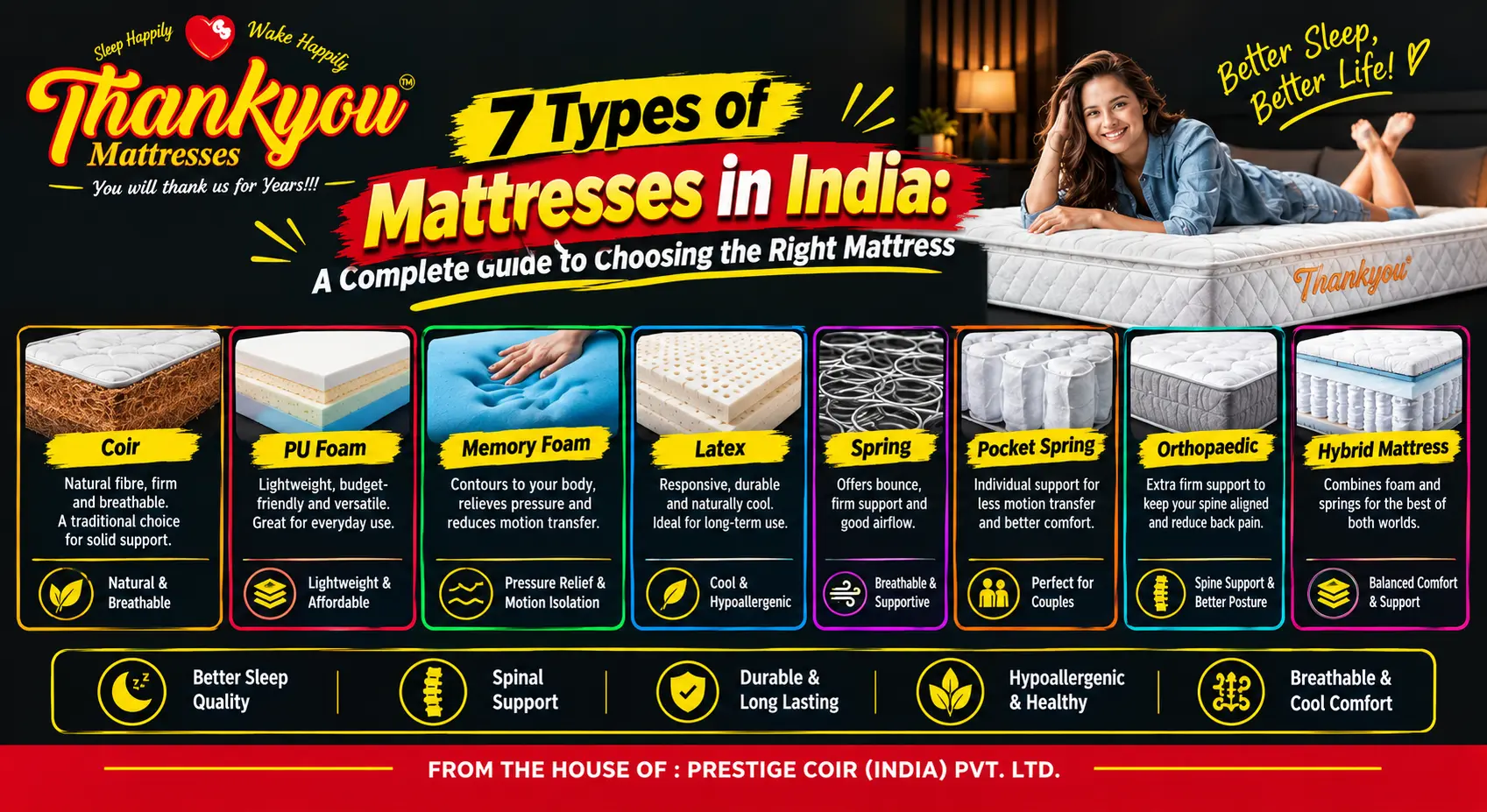
The 7 Types of Mattresses You’ll Run Into
1. Coir
Your grandparents probably slept on one of these. Coir is made from coconut husk fibre, pressed and bonded together, and it’s firm. Really firm. It breathes well, costs little and doesn’t sag easily.
- Good for: back sleepers, hot and humid cities, tight budgets
- Watch out: shoulders and hips can complain if you sleep on your side
2. PU Foam
This is the “just get me a bed” mattress. Light, cheap and found in every other shop. Quality swings wildly, though. Low-density foam gives up within a couple of years and develops a permanent dip right where you sleep.
- Good for: guest rooms, rentals, first homes
- Watch out: always ask for the density number, not just “premium quality”
3. Memory Foam
It slowly sinks around your body, which feels fantastic if you wake up with sore knees or a stiff shoulder. It also absorbs movement, so your partner’s 2 a.m. turnover won’t wake you.
- Good for: side sleepers, joint pain
- Watch out: it holds heat, so hot sleepers should look for gel or ventilated layers
4. Latex
Made from rubber tree sap, natural latex feels bouncy rather than sinky. It stays cooler than memory foam and naturally resists dust mites, which helps if you sneeze every morning.
- Good for: allergy-prone sleepers, anyone who wants a long-lasting bed
- Watch out: it’s heavy and expensive
5. Spring (Innerspring)
Steel coils sit inside, with padding on top. You get bounce, airflow and solid edges, so sitting on the side of the bed feels stable.
- Good for: people who like a traditional, springy feel
- Watch out: cheaper open-coil models get noisy with age and pass motion across the bed
6. Pocket Spring
Same idea as above, except every coil lives in its own small fabric pocket. They move on their own, so one person can toss around without shaking the other awake.
- Good for: couples, light sleepers
- Watch out: it costs noticeably more than regular spring
7. Orthopaedic
These are built to keep your spine reasonably straight, usually with a firm base and a thin soft layer on top. If your back aches every morning, start here. It can feel a bit flat on the first night or two, but most people settle in within a few weeks.
- Good for: back and neck problems
- Watch out: not the plushest option out there
Quick Comparison
| Type | Feel | Budget | Best for |
| Coir | Firm | Low | Back sleepers |
| PU Foam | Soft to medium | Low to mid | Everyday use |
| Memory Foam | Hugging | Mid to high | Side sleepers |
| Latex | Bouncy, medium-firm | High | Allergies |
| Spring | Firm, bouncy | Mid | Traditional feel |
| Pocket Spring | Medium | Mid to high | Couples |
| Orthopaedic | Medium-firm | Mid | Back pain |
Buying a Baby Mattress? Think Firm, Not Fluffy
Parents often assume a softer bed means a happier baby. It’s actually the opposite. A good baby mattress needs to be firm and flat, because soft surfaces increase suffocation risk and don’t support a growing spine properly.
Before you buy, check these:
- The mattress fits the cot snugly, with no gap at the sides
- Materials are non-toxic and gentle on skin
- The cover is waterproof but still breathable, and washable (you’ll wash it a lot)
- The core holds its shape, like firm coir or high-density foam
Your Pillow Matters More Than You Think
People spend big on the mattress and then rest their head on a lumpy, flat pillow from five years ago. Not a great plan. A pure cotton pillow is worth a look if you sleep hot or have sensitive skin, since cotton breathes and soaks up moisture without any synthetic stuffing. It’s firmer than polyester, and you’ll need to fluff it and put it out in the sun once in a while. Plenty of back and stomach sleepers actually like that firmness.
How to Actually Choose
Forget the sales pitch for a minute and ask yourself a few honest questions:
- How do I sleep? Side sleepers need some give. Back and stomach sleepers need support.
- How much do I weigh? Heavier bodies need denser foam or stronger coils, otherwise the bed sags early.
- What’s my city like? In humid places, coir, latex and spring tend to feel fresher.
- What does a mattress cost per year? A ₹30,000 mattress that lasts ten years is cheaper than a ₹10,000 one you replace every three.
- Is there a trial and a real warranty? Your body needs a few weeks to adjust, so don’t judge a bed in five minutes.
Where to Buy
Lying down on a mattress in person beats scrolling through product photos every time. If you’re in the capital region, going directly to mattress manufacturers in Delhi can save you the middleman’s cut and let you ask for custom sizes, thickness or firmness. Thankyou Mattresses is one such option, with different mattress types and bedding basics for different budgets.
Keep It Going Longer
- Flip or rotate it every few months so one spot doesn’t take all the wear
- Use a protector, because dust and spills quietly ruin mattresses
- Air it in the sun now and then, especially after the monsoon
- Don’t fold it, and don’t let kids use it as a trampoline
- Expect to replace it in 8 to 10 years, sooner if it sags
Final Word
There’s no single best mattress, only the best one for you. Like it firm? Try coir. Joint pain? Memory foam. Sharing a bed with a restless partner? Pocket spring. Cranky back? Go orthopaedic. Test a few, read the warranty and take your time. Your mornings will thank you.
Frequently Asked Questions
- Which mattress is best for back pain?
An orthopaedic or medium-firm mattress is usually best, as it supports the spine without feeling like a plank. Memory foam over a firm base also works well. - What are the main types of mattresses in India?
The most common are coir, PU foam, memory foam, latex, spring, pocket spring and orthopaedic. They differ in firmness, lifespan and price. - Is a coir mattress good for health?
Yes, it gives firm, breathable support that many back sleepers like. Side sleepers may find it too hard without a softer top layer. - How long does a mattress last?
A good one lasts 8 to 10 years. Low-density foam and basic coir often start sagging sooner. - Memory foam or pocket spring, which is better?
Memory foam relieves pressure better, while pocket spring offers more bounce, airflow and less motion transfer. Pick based on how you sleep and how warm you run. - What thickness should a mattress be?
Six to eight inches suits most adults. Heavier people may prefer eight to ten inches for better support. - What kind of mattress is safe for a baby?
A firm, flat, breathable mattress that fits the cot snugly. Choose a hypoallergenic, waterproof cover and avoid soft surfaces. - Is a cotton pillow better than a polyester one?
Cotton breathes better and absorbs moisture, so it suits warm sleepers and sensitive skin. It’s firmer and needs occasional fluffing and sunning. - How do I know it’s time to replace my mattress?
Sagging, lumps, creaking or waking up with aches are the usual signs. Worsening allergies can also point to an old mattress. - Should I buy a mattress directly from a manufacturer?
Often yes, since you may get better pricing, customisation and clearer warranty support. It also lets you try the mattress before you commit.
Leave a Reply