Most people spend about a third of their life asleep. And yet, when it comes to buying a mattress, the average person spends less time researching it than they would a new phone. That’s a bit of a problem.
The mattress market has exploded over the last decade. Walk into any store — or open any browser tab — and you’re immediately hit with terms like “memory foam,” “pocketed coils,” “latex,” “hybrid,” and half a dozen others. It can feel like you need a degree just to buy something to sleep on.
You don’t. But you do need to know the basics. Here’s a straightforward breakdown of the main mattress types, what each one actually does, and who it works best for.
1. Innerspring — The Classic That Still Works
Innerspring mattresses have been around for well over a century, and there’s a reason they haven’t disappeared. They work. A network of steel coils forms the core, giving the mattress its structure and bounce.
They’re not glamorous. But for a lot of sleepers — especially those who find foam mattresses suffocating or too soft — an innerspring is exactly what they need.
What makes them worth considering:
- They sleep cool. Air moves freely between the coils, so you don’t overheat the way you might on a solid foam mattress.
- They’re firm and responsive — you sit on top of them rather than sinking in.
- Edge support is usually strong, which matters if you share a bed or tend to sleep near the side.
- Generally more affordable than foam or hybrid options.
If you sleep on your stomach or your back, and you’ve always felt more comfortable on a firmer surface, an innerspring mattress probably suits you well. Side sleepers, however, often find them a bit unforgiving on the shoulders and hips.
2. Memory Foam — Loved by Millions for a Reason
Memory foam was originally developed for NASA aircraft seats — which is a fun fact that manufacturers have been happily repeating ever since. But beyond the origin story, the material genuinely delivers something different from traditional mattresses.
It responds to your body heat and weight, slowly contouring around you. That pressure relief is what makes it so popular among people with joint pain, shoulder issues, or anyone who’s tried everything else and still wakes up stiff.
The real advantages:
- Pressure relief is exceptional. It distributes your weight so no single point — shoulder, hip, lower back — bears too much load.
- It absorbs motion brilliantly. If your partner tosses and turns, you probably won’t feel it on a good memory foam mattress.
- It contours closely to the body, which side sleepers in particular tend to love.
- High-density versions are quite durable and hold their shape for years.
One thing worth pairing with a memory foam mattress: a contour memory foam pillow. The idea is that your mattress supports your spine from the waist down, but if your pillow doesn’t support your neck properly, you’re still going to wake up with stiffness. A contour memory foam pillow keeps the cervical spine aligned through the night — particularly useful if you deal with neck pain or wake up with headaches.
The common complaint about memory foam is heat retention. Traditional memory foam traps body heat, which can make summer nights uncomfortable. Gel-infused versions (more on that below) address this fairly well.
3. Latex — The One That Outlasts Everything Else
Latex mattresses don’t get as much attention as memory foam, but among people who’ve slept on one for years, there’s often genuine loyalty. Natural latex comes from rubber tree sap, making it one of the more eco-friendly options in the market.
The feel is different from foam — it’s bouncy and responsive rather than slow-sinking. You don’t feel “stuck” in a latex mattress the way some people do with memory foam.
Worth knowing:
- Naturally resistant to dust mites, mould, and allergens — a genuine advantage for people with allergies or asthma.
- Breathes well, so temperature regulation is better than most foam options.
- Exceptionally durable. A quality natural latex mattress can last 15 to 20 years with reasonable care.
- Responsive and supportive without the deep sink of memory foam — often preferred by those who find memory foam “too slow.”
The downside is cost. Good latex mattresses are not cheap, and synthetic latex (which is more affordable) doesn’t quite match the natural version in breathability or lifespan. But if you’re buying once and want it to last, the investment often makes sense.
4. Hybrid — When You Can’t Decide (and Don’t Have To)
Hybrid mattresses exist because a lot of people want more than one thing from their mattress. They want the support of coils but the comfort of foam. Or the bounce of springs but with better motion isolation. A hybrid is, at its core, a practical compromise — and for many sleepers, it’s the best answer.
The typical construction is a coil support layer at the base with foam, latex, or gel layers on top. The specifics vary a lot between brands, so what you actually get depends heavily on the quality and thickness of those comfort layers.
Where hybrids genuinely shine:
- More versatile than any single-material mattress — works across sleeping positions.
- Better airflow than all-foam, so they sleep cooler.
- Good edge support from the coil base, plus pressure relief from the foam layers above.
- Suits couples who have different sleeping preferences or body types.
If you’ve been going back and forth between foam and spring and can’t quite commit, a hybrid is worth trying. The price is usually mid-to-high range, but you’re effectively getting a more complete product.
5. Orthopedic Mattresses — Built Around Your Back
The term “orthopedic” gets used loosely in mattress marketing, but a genuinely orthopedic mattress is designed with spinal alignment as the priority. Firmer than average, with materials arranged to support the natural curve of the spine without letting it collapse or strain.
If you have chronic lower back pain, this category deserves serious attention.
The functional benefits:
- Keeps the spine in neutral alignment through the night — which is the single most important thing a mattress can do for back pain sufferers.
- Firm enough to prevent the sagging that misaligns the spine on softer mattresses.
- Often recommended by physiotherapists, especially post-injury or for people with degenerative disc issues.
- Tends to be well-suited for heavier individuals who need consistent support.
One thing to keep in mind: “firm” doesn’t always mean “orthopedic,” and “orthopedic” doesn’t mean it’ll feel uncomfortable. The goal is proper support, not punishment. The right orthopedic mattress should feel well-supported, not like sleeping on the floor.
6. Baby Mattresses — This One Requires Extra Care
This is where the rules change completely. Everything that makes an adult mattress comfortable — plushness, softness, contouring — is either irrelevant or actively unsafe for an infant.
Newborns and young babies cannot reposition themselves if they end up face-down on a soft surface. That’s why every pediatric and sleep safety guideline is consistent on this point: a baby mattress must be firm, flat, and snug-fitting within its cot or crib.
What to actually look for:
- Firmness first — no exceptions. The mattress should not compress more than an inch when pressed firmly.
- Breathable materials that prevent heat buildup, which is linked to safer sleep outcomes.
- A waterproof or easily cleanable cover — non-negotiable for hygiene, especially in the first year.
- Non-toxic materials. Babies breathe close to the mattress surface for many hours a day, so chemical-free construction matters.
- Precise sizing — the mattress should fit the cot frame with no gap larger than two fingers on any side.
Parents should ignore marketing language that emphasises softness or comfort features for babies. Safety certifications and material transparency are the only things that genuinely matter when buying a baby mattress.
7. Gel Foam — Memory Foam’s Cooler Sibling
Gel foam is essentially memory foam with a heat problem solved. Gel beads or gel layers are incorporated into the foam structure to draw heat away from the body rather than trapping it.
If you love the feel of memory foam but always found yourself kicking off the covers at 2am, gel foam is worth a look.
What it offers:
- Noticeably cooler than traditional memory foam — the gel actively pulls heat away from the sleeping surface.
- Retains all the pressure-relieving and motion-isolating qualities of standard memory foam.
- A good middle ground for hot sleepers who still want the contouring feel of foam.
The gap between gel foam and latex in terms of breathability is narrowing with newer constructions. For India’s climate specifically, gel foam or latex are worth prioritising over standard memory foam.
So, How Do You Actually Choose?
Honestly? Start with your sleeping position and your biggest complaint about your current mattress. That narrows it down faster than anything else.
- Waking up with back pain → look at orthopedic or medium-firm hybrid options.
- Disturbing your partner (or being disturbed) → memory foam or gel foam for motion isolation.
- Sleeping hot → latex, gel foam, or hybrid with a coil base.
- Joint pain in shoulders or hips → softer memory foam or a hybrid with a plush top layer.
- Allergies → natural latex, with a breathable cover.
- Buying for a baby → firmness, safety certification, non-toxic materials. Full stop.
Don’t get too distracted by brand claims and feature names. Focus on materials, density (for foam), and whether the feel matches how you sleep.
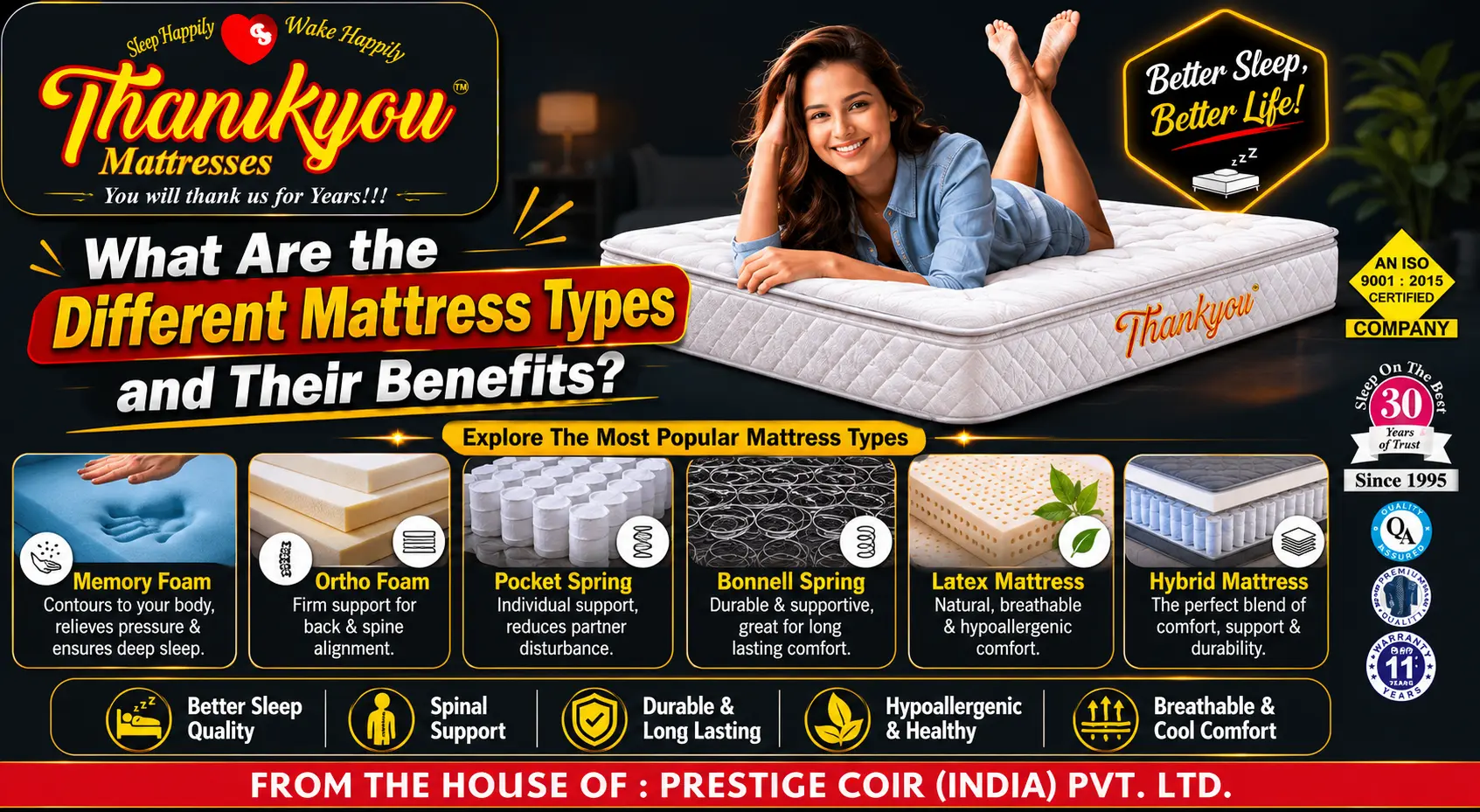
For buyers in the Delhi NCR region, Thankyou Mattresses is one of the established mattress manufacturers in Delhi, offering a range that covers foam, orthopedic, and baby mattress categories. Worth considering if you prefer buying from a manufacturer with local presence and after-sales accountability.
Final Thought
There’s no mattress that works for everyone. The “best” mattress is always relative to the person sleeping on it. But the good news is that once you understand what each type actually does — rather than just what the label says — the decision gets a lot easier.
Take your time with it. If a trial period is available, use it. A mattress purchase affects eight hours of every day of your life. That’s worth spending an extra week thinking about.
FAQs.
1. Which mattress type is best for back pain?
Orthopedic or medium-firm memory foam mattresses work best for most back pain sufferers — they keep the spine in neutral alignment and prevent the sagging that puts pressure on the lumbar region overnight.
2. What’s the actual difference between memory foam and spring mattresses?
Spring mattresses are firmer, more breathable, and bouncier — you sleep on top of them. Memory foam contours around you, isolates motion well, and excels at pressure relief, but retains more heat than springs.
3. How firm should a baby mattress be?
Very firm — it should barely compress when pressed with an open hand. Softness is a suffocation risk for infants who can’t reposition themselves, so firmness isn’t a preference here, it’s a safety requirement.
4. How long should a mattress realistically last?
Most foam and spring mattresses hold up well for 7 to 10 years. Natural latex is the outlier — a quality latex mattress can last 15 to 20 years. After 10 years, even a mattress that feels fine may no longer be supporting your spine correctly.
5. What is a hybrid mattress and is it worth it?
A hybrid combines a coil spring base with foam or latex comfort layers on top. It’s worth it if you want the breathability and bounce of springs with the pressure relief of foam — especially useful for couples with different sleeping styles.
6. Is latex better than memory foam?
Depends on the person. Latex is more breathable, durable, and responsive. Memory foam wins on motion isolation and deep pressure relief. If you sleep hot or want something eco-friendly, latex has the edge.
7. What mattress should a side sleeper use?
Side sleepers put the most pressure on their shoulders and hips, so they need softer pressure relief — medium to medium-soft memory foam or a hybrid with a cushioning top layer works best to prevent that sore-shoulder-in-the-morning feeling.
8. How does a contour memory foam pillow improve sleep?
A contour memory foam pillow supports the natural curve of the neck, keeping the cervical spine aligned while you sleep. It’s especially effective when paired with a memory foam mattress — together they support the full length of the spine, reducing neck stiffness and sleep-related headaches.
9. Which mattress is best for hot sleepers in India?
Latex or gel-infused foam mattresses are the practical choices for India’s heat. Both dissipate body heat better than standard memory foam, and open-cell or breathable constructions make a real difference through a humid summer night.
10. What should I look for when buying a mattress in India?
Foam density (higher is better for durability), material certifications, a meaningful trial period, and clear warranty terms. For local buyers, purchasing from reputable mattress manufacturers in Delhi or your city ensures you have someone accountable if something goes wrong after delivery.
Leave a Reply