Blog

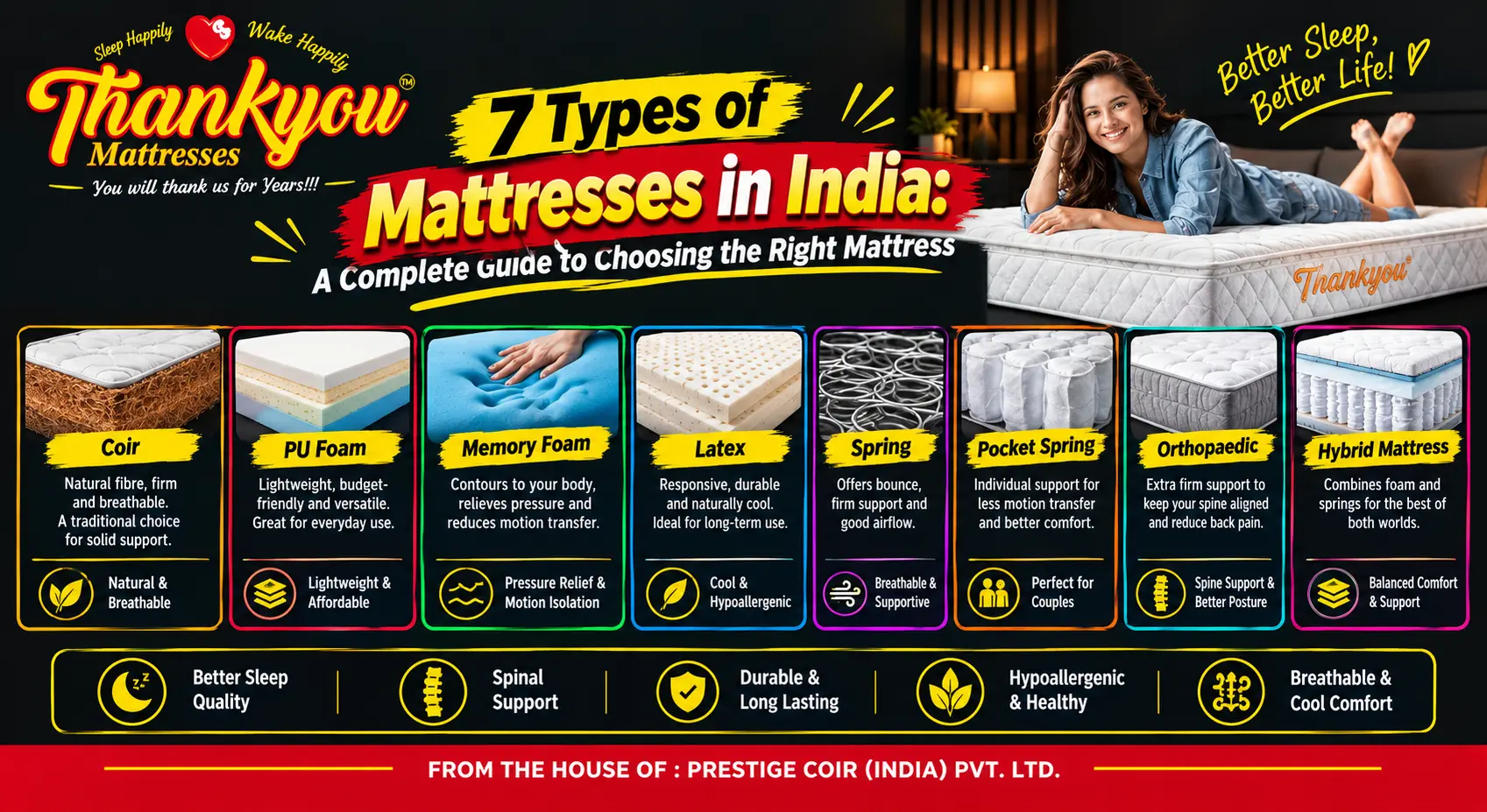
  • 7 Types of Mattresses in India: A Complete Guide to Choosing the Right Mattress

    7 Types of Mattresses in India: A Complete Guide to Choosing the Right Mattress

    Think about how you bought your last phone. Reviews, comparison videos, a week of overthinking. Now think about your last mattress. Chances are you lay on it for half a minute, said “yeah, seems fine,” and paid up.

    That’s odd, because you’ll spend roughly eight hours a day on it for the next decade. And in a country like ours, the choice isn’t simple. A mattress that feels great in a dry Jaipur winter can turn into a sweaty mess during a Mumbai monsoon. So let’s go through the main types of mattresses in India, what they’re really like, and who should skip them.

    The 7 Types of Mattresses You’ll Run Into

    1. Coir

    Your grandparents probably slept on one of these. Coir is made from coconut husk fibre, pressed and bonded together, and it’s firm. Really firm. It breathes well, costs little and doesn’t sag easily.

    • Good for: back sleepers, hot and humid cities, tight budgets
    • Watch out: shoulders and hips can complain if you sleep on your side

    2. PU Foam

    This is the “just get me a bed” mattress. Light, cheap and found in every other shop. Quality swings wildly, though. Low-density foam gives up within a couple of years and develops a permanent dip right where you sleep.

    • Good for: guest rooms, rentals, first homes
    • Watch out: always ask for the density number, not just “premium quality”

    3. Memory Foam

    It slowly sinks around your body, which feels fantastic if you wake up with sore knees or a stiff shoulder. It also absorbs movement, so your partner’s 2 a.m. turnover won’t wake you.

    • Good for: side sleepers, joint pain
    • Watch out: it holds heat, so hot sleepers should look for gel or ventilated layers

    4. Latex

    Made from rubber tree sap, natural latex feels bouncy rather than sinky. It stays cooler than memory foam and naturally resists dust mites, which helps if you sneeze every morning.

    • Good for: allergy-prone sleepers, anyone who wants a long-lasting bed
    • Watch out: it’s heavy and expensive

    5. Spring (Innerspring)

    Steel coils sit inside, with padding on top. You get bounce, airflow and solid edges, so sitting on the side of the bed feels stable.

    • Good for: people who like a traditional, springy feel
    • Watch out: cheaper open-coil models get noisy with age and pass motion across the bed

    6. Pocket Spring

    Same idea as above, except every coil lives in its own small fabric pocket. They move on their own, so one person can toss around without shaking the other awake.

    • Good for: couples, light sleepers
    • Watch out: it costs noticeably more than regular spring

    7. Orthopaedic

    These are built to keep your spine reasonably straight, usually with a firm base and a thin soft layer on top. If your back aches every morning, start here. It can feel a bit flat on the first night or two, but most people settle in within a few weeks.

    • Good for: back and neck problems
    • Watch out: not the plushest option out there

    Quick Comparison

    Type Feel Budget Best for
    Coir Firm Low Back sleepers
    PU Foam Soft to medium Low to mid Everyday use
    Memory Foam Hugging Mid to high Side sleepers
    Latex Bouncy, medium-firm High Allergies
    Spring Firm, bouncy Mid Traditional feel
    Pocket Spring Medium Mid to high Couples
    Orthopaedic Medium-firm Mid Back pain

    Buying a Baby Mattress? Think Firm, Not Fluffy

    Parents often assume a softer bed means a happier baby. It’s actually the opposite. A good baby mattress needs to be firm and flat, because soft surfaces increase suffocation risk and don’t support a growing spine properly.

    Before you buy, check these:

    • The mattress fits the cot snugly, with no gap at the sides
    • Materials are non-toxic and gentle on skin
    • The cover is waterproof but still breathable, and washable (you’ll wash it a lot)
    • The core holds its shape, like firm coir or high-density foam

    Your Pillow Matters More Than You Think

    People spend big on the mattress and then rest their head on a lumpy, flat pillow from five years ago. Not a great plan. A pure cotton pillow is worth a look if you sleep hot or have sensitive skin, since cotton breathes and soaks up moisture without any synthetic stuffing. It’s firmer than polyester, and you’ll need to fluff it and put it out in the sun once in a while. Plenty of back and stomach sleepers actually like that firmness.

    How to Actually Choose

    Forget the sales pitch for a minute and ask yourself a few honest questions:

    1. How do I sleep? Side sleepers need some give. Back and stomach sleepers need support.
    2. How much do I weigh? Heavier bodies need denser foam or stronger coils, otherwise the bed sags early.
    3. What’s my city like? In humid places, coir, latex and spring tend to feel fresher.
    4. What does a mattress cost per year? A ₹30,000 mattress that lasts ten years is cheaper than a ₹10,000 one you replace every three.
    5. Is there a trial and a real warranty? Your body needs a few weeks to adjust, so don’t judge a bed in five minutes.

    Where to Buy

    Lying down on a mattress in person beats scrolling through product photos every time. If you’re in the capital region, going directly to mattress manufacturers in Delhi can save you the middleman’s cut and let you ask for custom sizes, thickness or firmness. Thankyou Mattresses is one such option, with different mattress types and bedding basics for different budgets.

    Keep It Going Longer

    • Flip or rotate it every few months so one spot doesn’t take all the wear
    • Use a protector, because dust and spills quietly ruin mattresses
    • Air it in the sun now and then, especially after the monsoon
    • Don’t fold it, and don’t let kids use it as a trampoline
    • Expect to replace it in 8 to 10 years, sooner if it sags

    Final Word

    There’s no single best mattress, only the best one for you. Like it firm? Try coir. Joint pain? Memory foam. Sharing a bed with a restless partner? Pocket spring. Cranky back? Go orthopaedic. Test a few, read the warranty and take your time. Your mornings will thank you.

    Frequently Asked Questions

    1. Which mattress is best for back pain?
      An orthopaedic or medium-firm mattress is usually best, as it supports the spine without feeling like a plank. Memory foam over a firm base also works well.
    2. What are the main types of mattresses in India?
      The most common are coir, PU foam, memory foam, latex, spring, pocket spring and orthopaedic. They differ in firmness, lifespan and price.
    3. Is a coir mattress good for health?
      Yes, it gives firm, breathable support that many back sleepers like. Side sleepers may find it too hard without a softer top layer.
    4. How long does a mattress last?
      A good one lasts 8 to 10 years. Low-density foam and basic coir often start sagging sooner.
    5. Memory foam or pocket spring, which is better?
      Memory foam relieves pressure better, while pocket spring offers more bounce, airflow and less motion transfer. Pick based on how you sleep and how warm you run.
    6. What thickness should a mattress be?
      Six to eight inches suits most adults. Heavier people may prefer eight to ten inches for better support.
    7. What kind of mattress is safe for a baby?
      A firm, flat, breathable mattress that fits the cot snugly. Choose a hypoallergenic, waterproof cover and avoid soft surfaces.
    8. Is a cotton pillow better than a polyester one?
      Cotton breathes better and absorbs moisture, so it suits warm sleepers and sensitive skin. It’s firmer and needs occasional fluffing and sunning.
    9. How do I know it’s time to replace my mattress?
      Sagging, lumps, creaking or waking up with aches are the usual signs. Worsening allergies can also point to an old mattress.
    10. Should I buy a mattress directly from a manufacturer?
      Often yes, since you may get better pricing, customisation and clearer warranty support. It also lets you try the mattress before you commit.
  • How to Choose the Right Mattress Manufacturer in Delhi: Quality, Materials & Custom Options

    How to Choose the Right Mattress Manufacturer in Delhi: Quality, Materials & Custom Options

    Most people replace their mattress once every decade, maybe less. So when the time actually comes to buy one, it’s easy to feel a little lost — especially in a city like Delhi where every second shop claims to sell “the best” mattress. The truth is, quality varies a lot between manufacturers, and unless you know what to look for, you could end up paying premium prices for a mattress that sags within two years.

    This piece walks through what actually separates a good mattress manufacturer from an average one — and what you should be asking before you swipe your card.

    Why It’s Worth Being Picky About the Manufacturer

    Here’s the thing: a mattress isn’t just a piece of furniture. You spend roughly a third of your life on it. Bad support means bad sleep, and bad sleep eventually shows up as back pain, grogginess, or worse. So when you’re comparing mattress manufacturers in Delhi, don’t just look at price tags or showroom lighting. Look at what’s actually inside the product.

    What to Actually Look For

    1. The Materials Used

    This is where most of the “cheap vs. expensive” difference comes from. A few things worth checking:

    • Foam density (higher usually means it holds up longer)
    • Whether the foam has any safety or durability certification
    • The fabric on the cover — is it breathable, or will you be sweating by 3 AM?
    • How many layers the mattress actually has, since single-layer foam tends to flatten out fast

    Honestly, most buyers skip this step entirely and just go by how soft the mattress feels in the showroom. That’s a mistake — showroom softness and long-term support are two very different things.

    2. Whether They Cater to Different Needs

    A manufacturer that only makes one type of mattress is a red flag, in my opinion. Families usually need more than that. If there’s a newborn in the house, you’ll want a proper baby mattress — something firm enough to be safe, breathable enough to avoid overheating, and free of harsh chemical treatments. Not every manufacturer takes this seriously, so it’s worth asking directly rather than assuming.

    3. Can They Customise?

    Indian homes don’t always follow standard bed sizes — old furniture, custom carpentry, unusual room shapes. If you need a double bed mattress that isn’t the typical dimension, check whether the manufacturer can actually make one to size, or whether you’ll be stuck trimming a standard one yourself (which, for the record, ruins the internal structure).

    Firmness matters here too. Someone who sleeps on their side needs something softer around the shoulders and hips than someone who sleeps on their back. A decent manufacturer will ask about this instead of just selling you their bestseller.

    4. How Clean and Organised Is Their Production?

    If you get the chance, visit the factory or at least ask questions about it. Things worth knowing:

    • Is the unit clean, or does it look thrown together?
    • Do they run quality checks during production, or only at the end?
    • How is the mattress packed for delivery?

    You’d be surprised how much this affects the final product’s lifespan.

    5. What Happens After You Buy

    A mattress that comes with a vague “warranty available on request” isn’t reassuring. Look for a clear number of years, a real return policy, and a support team that actually responds when something’s wrong.

    6. What Other Buyers Are Saying

    Skip the testimonials on the manufacturer’s own website — of course those are positive. Check independent reviews instead, and pay attention to complaints about sagging, smell, or delivery issues more than star ratings.

    A Quick Word on Materials

    Not all mattress materials behave the same way:

    • Memory foam hugs the body and relieves pressure points, but can trap heat.
    • Latex breathes better and bounces back faster.
    • Coir is firm, budget-friendly, and holds up well for years — common in orthopedic mattresses.
    • Pocket springs work well for couples since movement on one side doesn’t disturb the other.

    And it’s not just about the mattress itself. What you rest your head on matters just as much. A pure cotton pillow, for instance, breathes better than synthetic fillings, doesn’t trap heat the same way, and tends to be kinder to sensitive skin — a small upgrade that makes a bigger difference than people expect.

    Where Thankyou Mattresses Fits In

    This is roughly the approach Thankyou Mattresses takes — prioritising the raw material quality first, then building in room for customisation rather than forcing everyone into the same three sizes. It’s a fairly simple philosophy, but it’s one a lot of manufacturers skip in favour of mass production.

    A Few Practical Tips Before You Buy

    1. Actually lie down on the mattress for a few minutes in the store — don’t just press it with your hand.
    2. Be wary of prices that seem too good to be true. Foam and fabric cost money; there’s usually a reason something’s cheap.
    3. Think about how you actually sleep — side, back, stomach — before picking firmness.
    4. Read the warranty terms properly, especially what voids it.
    5. Don’t forget the smaller stuff — pillows, protectors, toppers — they all add up to how well you sleep.

    Final Thoughts

    At the end of the day, picking a mattress manufacturer comes down to a handful of things: what materials they use, whether they’ll customise for your needs, and whether they stand behind what they sell. Whether you’re hunting for a reliable baby mattress, a properly sized double bed mattress, or even something as simple as a pure cotton pillow, the same rule applies — ask questions, check the fine print, and don’t get swayed by showroom lighting alone.

    FAQs People Actually Search

    1. What should I check before buying a mattress from a manufacturer in Delhi?
    Look at foam density, certifications, warranty terms, and genuine customer reviews rather than relying on showroom appearance alone.

    2. How is a baby mattress different from a regular one?
    It’s firmer for safety, more breathable to prevent overheating, and made without harsh chemical treatments.

    3. What’s the standard size for a double bed mattress in India?
    Usually around 4×6.5 feet, though most manufacturers can customise it for non-standard bed frames.

    4. Are pure cotton pillows actually better than synthetic ones?
    Generally yes — they breathe better, trap less heat, and tend to suit sensitive skin more than synthetic fillings.

    5. How long does a mattress usually last?
    Most last 7 to 10 years, though this depends heavily on material quality and how it’s used.

    6. What firmness is best for someone with back pain?
    Medium-firm tends to work best for most people, balancing support with comfort.

    7. Will manufacturers actually customise size or firmness on request?
    Many will, especially smaller or mid-sized manufacturers — it’s always worth asking directly.

    8. What’s a good material choice for people who sleep hot?
    Latex or gel-infused memory foam tend to trap less heat than regular foam.

    9. Coir or memory foam — which is better?
    Depends on preference: coir is firmer and more durable, memory foam is softer and better for pressure relief.

    10. How can I tell if a mattress manufacturer is actually reliable?
    Check for transparency about materials, real (not curated) reviews, clear warranty terms, and responsive customer support.


  • What 30+ Years of Making Mattresses in Delhi Taught Us About Real Comfort

    What 30+ Years of Making Mattresses in Delhi Taught Us About Real Comfort

    Someone walked into a mattress showroom last year, pressed their hand down on four or five options, and picked the softest one. Eighteen months later they were on the phone with customer care, asking why their back hurt every single morning.

    This happens more often than you’d think. And it’s the whole reason this post exists — because there’s a real gap between what feels good for five seconds under your palm and what your body actually needs across eight hours, every night, for years. You don’t see that gap from a showroom floor. You see it after decades of making the things.

    A Palm Test Tells You Almost Nothing

    Your hand doesn’t weigh 70 kilos. It doesn’t stay in one spot all night. It definitely doesn’t sweat through a Delhi summer at 3 AM with the fan barely cutting through the heat.

    Real comfort is a slower thing to judge. It comes down to whether the foam underneath is dense enough to hold its shape past year one, whether there’s a proper base giving your spine something to rest against instead of just swallowing it whole, and whether the material actually breathes when the room heats up. None of that shows up when you press your hand down for a few seconds in a shop. It shows up later — sometimes a lot later, which is worse.

    Not Everyone Should Be Sleeping on the Same Mattress

    Somewhere around the thousandth customer, a pattern gets impossible to ignore: a side sleeper, a back sleeper, and someone nursing an old shoulder injury are basically three different people with three different needs, even though none of them would ever put it that way themselves.

    That’s honestly a big part of why the relaxo mattress has stuck around as a go-to option for so many households. It sits in that awkward middle zone — not too firm, not too soft — that ends up fitting more people than either extreme does. It’s not glamorous. It’s just the one that doesn’t get complaints six months later.

    If a manufacturer is only making one kind of mattress, be a little suspicious. That usually says more about their factory line than your spine.

    Materials Don’t Age the Way You’d Expect

    This is the part almost nobody thinks about while they’re buying. Two mattresses can feel exactly the same on day one and completely different by year three.

    Low-density foam flattens fast, no matter how firm it felt in the showroom that day. Coir holds up decently and stays breathable — but only when it’s layered right, otherwise it just goes stiff and unpleasant instead of supportive. Memory foam needs the right density, or it turns soft and shapeless within a couple of years. And rebonded foam is fine as a base layer, but it was never meant to carry a mattress on its own.

    Nobody sees this at the point of sale. You see it in the warranty calls that come in three, four, five years later — which, honestly, is where a lot of the real learning happens.

    The Pillow Nobody Thinks About

    People will spend weeks comparing mattresses and then grab whatever pillow is sitting on the shelf next to the one they picked. Which is a bit backwards, because your neck doesn’t care how good the mattress is if your head’s tilted at the wrong angle all night.

    A contour memory foam pillow is shaped to follow the curve of your neck instead of fighting it, and that’s a big part of why people who switch to one notice less stiffness within a week or two. If you run hot at night — and a lot of people in Delhi do, especially between April and July — a pure cotton pillow is still hard to beat. It just breathes better than synthetic fill, and that matters more than most people realize until they’ve tried it.

    Mattress and pillow really aren’t two separate purchases. Treating them that way is usually how someone fixes one problem while quietly creating another.

    What Separates the Manufacturers Still Standing After 30 Years

    Delhi has no shortage of people selling mattresses. What’s rare is a manufacturer that’s still around three decades later, and it usually comes down to a few boring habits rather than anything flashy:

    Sticking with the same quality foam or coir supplier instead of switching every time costs shift a little. Testing durability in-house, before a mattress ever leaves the factory, not after complaints start rolling in. Actually saying yes to odd-sized beds, hospital cots, or bulk hotel orders instead of pushing everyone toward the standard sizes because they’re easier to produce. And writing warranty terms that are specific enough to survive an actual claim, instead of vague language that falls apart the moment someone tries to use it.

    Among mattress manufacturers in Delhi, the ones that last this long are usually the ones that never treated any of that as optional.

    So What’s the Real Lesson Here

    You can’t judge a mattress standing in a showroom for two minutes, no matter how many times you press down on it. Comfort gets decided months earlier — in the choice of materials, in how the layers are put together, in the testing nobody sees — long before it ever reaches your bedroom.

    At Thankyou Mattresses, that’s basically been the whole approach for over 30 years: build for the tenth year of use, not the first impression in a shop. The mattresses people actually stay happy with aren’t the ones that wowed them on day one. They’re the ones they eventually stopped thinking about entirely — because they just worked, night after night, without asking for attention.

    Frequently Asked Questions

    What makes a mattress last longer than others?
    It mainly comes down to foam or coir density and consistent material sourcing — not the price tag on the label.

    Is a Relaxo mattress suitable for all sleeping positions?
    Its medium firmness generally suits back, side, and combination sleepers, though very heavy or very light individuals might prefer firmer or softer options.

    How often should a mattress be replaced?
    Most need replacing every 7 to 10 years, though heavy daily use or lower-quality materials can shorten that.

    What’s the difference between memory foam and coir mattresses?
    Memory foam contours closely to the body for pressure relief, while coir stays firmer and more breathable, which works well in India’s warmer months.

    Why does the pillow matter as much as the mattress?
    A mismatched pillow can undo good spinal alignment by leaving the neck tilted wrong all night, even on a great mattress.

    What is a contour memory foam pillow best suited for?
    It follows the natural curve of the neck, which helps people who regularly wake up with neck or shoulder stiffness.

    Is a pure cotton pillow a good choice for hot weather?
    Yes — cotton fill breathes better than synthetic alternatives, which makes a real difference on hot, humid nights.

    Can mattresses be made for non-standard bed sizes?
    Yes, most established manufacturers can customize dimensions for odd-sized beds, hospitals, hotels, or guest houses on request.

    Do all mattress manufacturers in Delhi offer similar warranties?
    No — coverage varies quite a bit between brands, so it’s worth checking exactly what counts as a manufacturing defect versus misuse.

    Can mattress firmness actually affect back pain?
    Yes, mattresses that are too soft or too firm can affect spinal alignment, which is why medium support is often preferred for people dealing with back discomfort.


  • Mattress Myths You Should Stop Believing

    Mattress Myths You Should Stop Believing

    Ask five people what makes a “good” mattress and you’ll probably get five different answers — most of them wrong. Mattress advice in India gets passed around like a family recipe: from parents, from the uncle who swears by his 20-year-old cotton-filled bed, from the salesman who just wants to close a sale before lunch. Somewhere along the way, a lot of half-truths hardened into “facts.”

    We’re Thankyou Mattresses, and honestly, we’d rather you buy the right mattress from anywhere than the wrong one from us. So here’s a rundown of the myths we hear most often, and what’s actually true.

    “Harder is always better for your back”

    This one refuses to die. Somehow an entire generation grew up believing that if a mattress doesn’t feel like sleeping on a plank of wood, it’s not doing its job.

    Here’s the problem: a mattress that’s too firm doesn’t support your spine — it just pushes back against it. Your shoulders and hips, being the widest parts of your body, end up taking all the pressure while the rest of you barely touches the surface. Over time that’s a recipe for stiffness, not relief.

    What your spine actually wants is something closer to medium-firm — support that still holds its shape but gives a little where your body needs it to. That’s part of why contour memory foam pillow designs caught on the way they did. Instead of forcing your neck to adjust to the pillow, the pillow adjusts to your neck.

    “One mattress is pretty much like another”

    It’s tempting to think mattresses are interchangeable once they’re covered in the same white fabric. They’re not, and the difference usually isn’t visible from the outside. A few things that actually separate a decent mattress from a mediocre one:

    • What’s inside — foam, latex, springs, or some hybrid mix of all three
    • How the layers are built, since that’s what determines whether it lasts five years or fifteen
    • How well it breathes, especially if you tend to sleep warm
    • Edge support, which matters more than people expect if you sit on the bed a lot

    This is also where it helps to know who actually made your mattress. Some of the more established mattress manufacturers in Delhi have been refining their layering and foam density for years — it’s not something you can shortcut by copying a design and slapping on a new label.

    “The more expensive it is, the better it must be”

    Not really. Price tags in this category are heavily influenced by advertising budgets, showroom rent, and brand positioning — not always by what’s inside the mattress. We’ve seen premium-priced mattresses that are, frankly, unremarkable, and mid-range ones that outperform them on every measurable front.

    If you want a better filter than price, look at the warranty length, the return or trial policy, and whether the brand is upfront about the materials used. That tells you more than a number on a tag ever will.

    “You’ll know it’s time to replace it when it looks worn out”

    By the time a mattress visibly sags, it’s usually been failing you quietly for a year or two already. Most mattresses have a realistic lifespan of 7 to 10 years, and the decline is gradual — you wake up a little stiffer, you shift positions more at night, you blame it on stress or your pillow. Rarely do people connect it back to the mattress itself until it’s obviously falling apart.

    If you’re waking up with aches that ease up once you’re out of bed and moving around, that’s usually your mattress talking, not your body.

    “The pillow doesn’t matter much, as long as the mattress is good”

    The mattress gets all the credit, but your neck and shoulders don’t care how good your mattress is if your pillow is flat, lumpy, or trapping heat all night. This is one area where a pure cotton pillow earns its reputation — breathable, low on synthetic buildup, and generally kinder to people with allergies or sensitive skin. Get the mattress right and ignore the pillow, and you’ve really only solved half the problem.

    “Memory foam always sleeps hot”

    Fair complaint, outdated by now. Early memory foam did trap heat — that reputation wasn’t invented out of nowhere. But foam manufacturing has moved on quite a bit since then. Gel-infused layers, open-cell structures, better airflow channels — a lot of modern foam is built specifically to stop that heat-trapping problem, so judging it by decade-old standards isn’t really fair anymore.

    “Everyone in the house can share the same type of mattress”

    Convenient in theory, rarely true in practice. A side sleeper needs more give at the shoulder and hip. A back sleeper usually wants firmer, more even support. Throw in differences in body weight and age, and “one mattress fits all” starts to look more like a compromise everyone tolerates than a solution anyone’s happy with.

    “Five minutes in a showroom tells you everything”

    It really doesn’t. Lying on a mattress for a few minutes under showroom lighting, fully dressed, mid-afternoon, tells you almost nothing about how it’ll feel at 3 a.m. after a long day. Your body needs a few nights — sometimes a couple of weeks — to actually settle in and reveal whether a mattress works for you. That’s exactly why trial periods exist, and why skipping straight to a decision in-store is one of the more common regrets we hear about.

    The takeaway

    Most mattress myths survive simply because nobody questions them — they get repeated often enough that they start to sound like common sense. But your spine, your sleep, and your budget deserve better than inherited assumptions. Look past the marketing, ask about materials, take advantage of trial periods, and pick what actually works for your body — not what everyone else says worked for theirs.

    FAQs

    1. Is a firm mattress really better for back pain?

     Not always — a medium-firm mattress usually supports the spine better than an overly hard one, which can create pressure points at the hips and shoulders.

    1. How long does a mattress actually last?

     Around 7 to 10 years on average, though support quality often declines gradually before any visible wear shows up.

    1. Does a higher price always mean a better mattress?

     No — price is often driven by marketing and branding, so warranty terms and material quality are better indicators of value.

    1. Does memory foam still sleep hot?

     Not as much as it used to. Newer foam designs use gel infusions and open-cell structures that significantly improve airflow.

    1. Can one mattress work for every family member?

     Not really — sleeping position, body weight, and age all affect what firmness level actually feels comfortable and supportive.

    1. How important is the pillow compared to the mattress?

     Just as important. A poor pillow can undo the neck and shoulder support that a good mattress provides.

    1. What’s the benefit of a pure cotton pillow?

     It’s breathable, low-allergen, and generally more comfortable for people who sleep warm or have sensitive skin.

    1. How can I tell if a mattress is good quality?

     Check the core material, layering, breathability, and edge support rather than relying on how it looks or feels for a few minutes.

    1. Why do mattress trial periods matter?

     Because it takes several nights for your body to properly adjust, a short showroom test can’t predict long-term comfort.

    1. What should I look for in a mattress manufacturer?

     Look for established manufacturers with clear certifications, consistent quality control, and transparent warranty policies.


  • What Is the Best Mattress for Pregnant Women?

    What Is the Best Mattress for Pregnant Women?

    Ask a mom-to-be about her sleep habits, and she is likely to give a weary chuckle in response. As soon as you reach the second trimester, the stomach swells, the hips ache and that old mattress that used to work fine no longer does. Sound familiar?

    Here’s the thing — most people don’t think about their mattress until it starts causing problems. But during pregnancy, it’s worth paying attention early. Finding the best mattress for pregnant women isn’t about luxury or trends, it’s about giving your changing body the support it actually needs, night after night.

    So here’s what you need to know when making your choice.

    Why Your Old Mattress Is No Longer an Option

    During pregnancy, your body is not what it used to be when you bought your old mattress. The extra weight changes your center of gravity, the joints become more flexible (thanks to those pesky hormones), and the mattress that was just right before becomes too hard or too soft.

    Here are a few problems that appear regularly:

    • Nagging lower back or hip pain
    • Spending half the night trying to get comfortable
    • More tossing and turning than actual sleeping
    • Sleep that gets lighter and more broken as the months go on

    None of this is unusual, but it doesn’t have to be your normal either. A mattress that actually adjusts to your shape — instead of fighting against it — can take a lot of that discomfort off the table.

    So, What Should You Actually Look For?

    Firmness that’s somewhere in the middle. Too soft, and you sink in awkwardly, throwing your spine out of line. Too firm, and every pressure point protests. A medium-firm mattress usually hits that sweet spot between support and cushioning.

    Real pressure relief. Since side-sleeping is what most doctors recommend during pregnancy, your hips and shoulders take the brunt of it. This is where memory foam or hybrid designs tend to shine — they mold to your body instead of pushing back against it.

    Minimal motion transfer. If you share a bed, you already know how one person shifting can wake the other. A mattress that isolates movement well means fewer 3 a.m. wake-ups just because your partner rolled over.

    Breathability. Night sweats are common during pregnancy, and nobody wants to wake up overheated. Materials that let air flow through make a noticeable difference here.

    Solid edge support. Getting in and out of bed gets trickier as your belly grows. A mattress with good edge support makes that whole process a bit less of a struggle.

    If you’re exploring options, Thankyou Mattresses is one brand that’s built around exactly this — a mix of support, airflow, and pressure relief meant for changing sleep needs, pregnancy included.

    And Don’t Skip the Pillow

    Truthfully, individuals often underrate this. The pillow plays an important role in supporting your neck and shoulder regions at night.

    A memory foam pillow shapes itself around your neck, which helps if you’re spending hours on your side (which, during pregnancy, you probably are). And a pure cotton pillow cover keeps things breathable and soft against the skin — small detail, but it matters when your skin feels more sensitive than usual.

    In addition to that, most women during pregnancy like using an additional pillow between the legs or behind the back. The idea might seem small, but it is effective.

    While You’re At It — Think About the Baby Mattress Too

    It’s easy to focus entirely on your own comfort right now, but this is also a good stretch to start looking into your baby’s first mattress. There’s no need to rush, but a few things are worth checking:

    • It should be firm — soft bedding isn’t considered safe for infants
    • No strong chemical smells or questionable materials
    • Breathable fabric to avoid overheating
    • A snug fit in the crib, with no gaps along the sides

    Getting this sorted early means it’s one less thing on your list closer to your due date.

    A Few Extra Sleep Tips Worth Trying

    Beyond the mattress and pillow, small habits can add up:

    1. Sleep on your left side since this aids in the flow of blood to both mother and baby.
    2. Sleep with a pregnancy pillow to support your back and stomach.
    3. Ensure that you have a regular bedtime, including during weekends.
    4. Avoid eating large amounts of food or taking caffeine late in the evening.
    5. Keep the room cool and dark; it will really help you sleep better.

    Wrapping Up

    At the end of the day, choosing the best mattress for pregnant women comes down to listening to what your body’s telling you — because it’s telling you a lot right now. Pair the right mattress with a supportive memory foam pillow or a breathable pure cotton pillow, and you’ll likely notice the difference within a few nights. And when you get a spare moment, it’s worth looking into a proper baby mattress too — future you will be glad you did.

    Better sleep now means a better start for both of you later.

    Frequently Asked Questions

    1. What type of mattress is best during pregnancy?
      A medium-firm memory foam or hybrid mattress is generally best, as it offers pressure relief while keeping the spine aligned.

    2. Is a soft or firm mattress better for pregnant women?
      A medium-firm mattress is ideal — too soft can misalign the spine, while too firm can increase pressure on the hips and shoulders.

    3. Can a bad mattress cause back pain during pregnancy?
      Yes, an unsupportive mattress can worsen back and hip pain by failing to keep the spine properly aligned during sleep.

    4. What is the best sleeping position for pregnant women?
      Sleeping on the left side is recommended, as it improves blood circulation to the baby and reduces pressure on internal organs.

    5. Do pregnant women need a special pillow?
      A supportive pillow, such as a memory foam pillow, helps align the neck and shoulders, especially for side sleepers.

    6. When should I buy a baby mattress?
      It’s ideal to start shopping for a baby mattress in the second trimester, giving you enough time to research safe, quality options.

    7. What should I look for in a baby mattress?
      Look for firmness, breathability, a snug crib fit, and materials free from harmful chemicals.

    8. Are cotton pillows good for pregnancy?
      Yes, a pure cotton pillow is breathable and gentle on sensitive skin, making it a comfortable choice during pregnancy.

    9. How often should I change my sleeping position at night?
      It’s normal to shift positions throughout the night; using pillows for support can make these transitions more comfortable.

    10. Does mattress firmness need to change with each trimester?
      Not necessarily, but many women find they need more pressure relief and support as pregnancy progresses into the later trimesters.
  • Which Mattress Is Best for Senior Citizens? A Complete Buying Guide

    Which Mattress Is Best for Senior Citizens? A Complete Buying Guide

    Which Mattress Is Best for Senior Citizens? A Complete Buying Guide

    Older adults require quality sleep because of its direct correlation with good health. Joint pain, lack of mobility, and sleep disturbances are some problems that older adults face and most of them result from one thing – the mattress they sleep on. It is important to buy the right mattress for senior adults since the mattress affects several aspects including spinal alignment, blood circulation and recovery during sleeping. The following tips will provide insight into what factors matter when buying mattresses for older adults.

    Why Mattress Choice Matters More With Age

    Senior adults spend more hours in bed compared to younger people and they also have increased sensitivity to pressure points, temperature and support. A mattress that worked well at 30 years of age may not work well at 65 years of age. Some common problems that an older adult suffers from and that can be corrected by using the right mattress include:

    • Joint pain caused by arthritis or lack of cartilage padding
    • Poor blood flow, which can increase due to too much pressure on hips and shoulders
    • Problems getting into or out of bed, usually related to mattress softness and reinforced edges
    • Temperature sensitivity, since many seniors sleep hot or cold more easily
    • Fragmented sleep, which a supportive surface can help reduce

    Key Features to Look for in a Senior-Friendly Mattress

    1. Medium-Firm Support

    Too soft, and the body sinks unevenly, straining the spine. Too firm, and pressure points build up at the hips and shoulders. A medium-firm mattress typically offers the right balance — enough support for the spine while still cushioning key pressure areas.

    2. Pressure Relief for Joints

    Materials that adapt to the shape of the body, including memory foam layers, assist in spreading the weight evenly. It helps relieve hips, knees, and shoulders — areas where most seniors experience pain while sleeping.

    3. Easy Edge Access

    Reinforced edges enable getting out of bed or sitting down easily without making the surface collapse inwards, which is convenient for seniors who have trouble moving around.

    4. Breathability and Temperature Regulation

    Cooling covers and breathable materials help prevent overheating, which can disrupt deep sleep — a stage that’s already harder to reach with age.

    5. Motion Isolation

    When buying a mattress for two people, choosing one that prevents motion transfers ensures that one person will not affect the other when getting out of bed or changing positions.

    Pillows Matter Just as Much as the Mattress

    A mattress alone doesn’t complete a good sleep setup. Pillow choice plays an equally important role, especially for neck and shoulder support.

    • Pure cotton pillows are suitable for seniors who have sensitive skin or suffer from various allergies since the material is hypoallergenic and easy to wash.
    • Pillow types that use memory foam pillow to the shape of the neck and head and thus provide good support for the spine.

    The choice of the right mattress and pillow will help minimize stiffness in the mornings and will generally make your sleep more comfortable.

    What About Multi-Generational Households?

    Modern families usually consist of grandparents, parents, and children, and that is why there might be quite diverse sleep requirements among the members of a family. Seniors, on the contrary to infants, need mattresses that are very hard and offer good pressure relief, but the sleeping conditions that babies need are very different. Thus, a good baby mattress must be firm and breathable, without the use of any chemicals that are dangerous for babies, unlike adult mattresses. Such mattresses are produced by brands like Thankyou Mattresses.

    Materials Commonly Used in Senior-Friendly Mattresses

    Material Benefit for Seniors
    Memory Foam Contours to the body, relieves joint pressure
    Latex Naturally breathable, responsive support
    Pocket Springs Good motion isolation, targeted support zones
    Hybrid (Foam + Springs) Combines pressure relief with edge support

    Hybrid beds tend to be advised for seniors due to the combination of both the contouring properties of foam and the resilience provided by the springs. This allows for easier movement when changing positions and getting up.

    Recommended Products for Senior Citizens

    With regard to seniors, the requirement would be a bed that provides both stability and easy mobility while providing cushioning. With that in mind, here are three types of beds which would be highly effective in this situation:

    • Orthopedic Bed – Best for those seniors who prefer firmer beds and a stable sleeping surface that will not have any sinking-in effect. Suitable for those people who experience some level of back problems and do not want an excessively soft mattress.
    • Memory Elegance (6-inch) — Built with High Resilience (HR) Foam and a Memory Foam top layer, this option offers the medium-firm balance most seniors need — enough support for the spine, with just enough contouring to ease pressure on hips and shoulders.
    • Memory Plus Memory (7-inch) — A good fit for seniors who want extra cushioning without losing firm underlying support, thanks to its HR Foam base topped with two layers of memory foam.

    Out of the above three types, the most ideal option for senior people will be Memory Elegance (6 inch).

    How to Choose the Right Firmness Level

    Firmness needs can vary based on body weight and existing health conditions:

    • Lower body weight (less than 60 kg): A softer medium-firm model is usually the best choice, giving you cushioning while preventing too much sinking.
    • Medium body weight (60-90 kg): A regular medium-firm mattress will be your optimal choice.
    • Higher body weight (over 90 kg): You need firmer support and enhanced edges that can provide you with a stable position.

    Also, you should think about such conditions as arthritis, sciatica, and recovery after an operation that might require extra pressure relief.

    Maintenance Tips for Longevity

    • The rotation of the mattress once every three to four months will help with equal wear and tear.
    • Choose breathable mattress protectors to protect yourself from spillages and dust mites.
    • Air out your mattress regularly, especially if you live in a humid climate.
    • Change your pillows every 12 to 18 months because they become ineffective as time passes by.

    Final Thoughts

    Selecting the best mattress for senior citizens comes down to balancing support, pressure relief, and ease of movement. Models like the Memory Elegance (6-inch) or the Orthopedic Mattress are worth shortlisting for exactly this reason — they prioritize stability and joint relief over plush sinkage. Pairing the right mattress with a suitable pillow — whether a breathable pure cotton pillow or a contouring memory foam pillow — completes a sleep setup that genuinely supports healthy aging. For households with varying needs, from grandparents to newborns requiring a safe baby mattress, choosing quality-focused, purpose-built products makes a meaningful difference in everyone’s sleep quality and long-term comfort.

    Frequently Asked Questions

    1. What is the best mattress firmness for senior citizens?

    Medium-firm mattresses are generally best, as they support the spine while cushioning pressure points at the hips and shoulders.

    1. Is memory foam good for elderly people?

    Yes, memory foam contours to the body and relieves joint pressure, making it a popular choice for seniors with arthritis or joint pain.

    1. How often should seniors replace their mattress?

    Most mattresses should be replaced every 7–8 years, or sooner if sagging, discomfort, or reduced support is noticeable.

    1. What type of pillow is best for neck pain in seniors?

    A memory foam pillow is often recommended, as it contours to the neck and head, helping maintain spinal alignment overnight.

    1. Are cotton pillows good for sensitive skin?

    Yes, a pure cotton pillow is breathable and hypoallergenic, making it suitable for seniors with allergies or sensitive skin.

    1. Do hybrid mattresses work well for older adults?

    Yes, hybrid mattresses combine foam’s pressure relief with spring support, offering both comfort and easier mobility for seniors.

    1. What firmness is recommended for a baby mattress?

    A baby mattress should be firm and breathable, since soft surfaces increase suffocation risk for infants.

    1. Can the wrong mattress worsen back pain in seniors?

    Yes, mattresses that are too soft or too firm can misalign the spine, increasing pressure on the back and joints over time.

    1. How does mattress choice affect sleep quality in older adults?

    A supportive mattress reduces pressure points and discomfort, helping seniors reach deeper, more restorative sleep stages.

    1. Should seniors consider cooling mattress features?

    Yes, breathable and cooling materials help regulate body temperature, which can otherwise disrupt sleep in older adults.

    1. Which specific mattress is best for senior citizens?

    The Memory Elegance (6-inch), built with HR Foam and a Memory Foam top layer, is a strong choice for seniors, offering medium-firm support with balanced pressure relief for joints.


  • How to Clean a Mattress at Home: A Step-by-Step Guide

    How to Clean a Mattress at Home: A Step-by-Step Guide

    Here’s something you’ll probably only start thinking about once you’ve stripped the bed to discover its secrets. Sheets, towels and bedding are washed and changed regularly; floors are cleaned with vacuum cleaners and counters with a wet cloth, while mattresses remain unattended for decades. And it is definitely a flaw because mattress fabric silently absorbs perspiration, dust, skin cells and all sorts of dirt that somehow manage to penetrate through the sheets.

    If you’re wondering how to clean a mattress without damaging it, you’ve come to the right place. In this guide, we will describe how to make the job easy to do – all you need are your hands and some products you probably have around your house.

    Why Bother Cleaning a Mattress You Can’t Even See Under the Sheets?

    Fair question. But consider this: a mattress you sleep on for 7-8 hours a night, every night, is bound to pick up more grime than almost anything else in your house.

    A few reasons it’s worth the effort:

    • Dust mites feel good about their environment in the mattress fabric. Allergy sufferers will experience sneezing and itchy eyes due to the presence of these tiny insects.
    • Moisture of sweat accumulates for years and gives the perfect breeding ground to bacteria and other microorganisms causing odors.
    • Stains are not easily removed from the mattress fabric, and eventually they become permanent.
    • In case of neglect, the mattress will wear out faster and will be unable to provide comfortable sleep.

    None of this means you need to deep-clean every weekend. A little consistency is all it takes.

    The Actual Cleaning Process

    Start by stripping everything off

    Toss the bed sheets, pillow covers, and even the mattress cover into a hot wash cycle, to remove the dust mites and bacteria which have been multiplying in the fabric which touches your skin daily.

    Vacuum like you mean it

    Grab the upholstery attachment and go over the whole surface slowly. Don’t rush the edges and seams — that’s usually where the most dust collects, and it’s the part people skip. If your mattress can be flipped, do both sides while you’re at it.

    Deal with stains before they become permanent

    Fresh spill? Blot it immediately with a dry cloth — don’t rub, since that just pushes the liquid deeper into the padding. For stains that have already dried in, a few home remedies work surprisingly well:

    • A paste of baking soda and a splash of water, left on the stain for 15-20 minutes before wiping away, handles most everyday marks.
    • A drop of mild dish soap in water is gentle enough for sweat stains and won’t damage most fabric covers.
    • For stubborn stains like blood, a mix of hydrogen peroxide and baking soda tends to do the trick — just test a small hidden patch first to be safe.

    Let baking soda pull out the smell

    This is the step people are often surprised by. Sprinkle baking soda generously across the whole mattress and just leave it — ideally overnight. It absorbs moisture and odour while you sleep elsewhere (or on the sofa, just for one night). Vacuum it off in the morning and you’ll notice the difference immediately.

    Give it some sunlight if you can

    If you live in a flat, then that might not be practical but if there’s a balcony or some space by a window where sunlight shines, prop the mattress upright for about two hours, as sunlight is a disinfectant.

    Protect it going forward

    Once it’s clean, don’t skip this part — get a breathable, waterproof mattress protector on it. It’s a small investment that saves you from repeating this entire process every few weeks.

    If You Own an Orthopedic Mattress

    These are built differently — layered foam designed to support your spine — so cleaning them the same way you’d clean an old spring mattress isn’t a great idea.

    A few things worth keeping in mind:

    • Do not wash it at all. The water seeps into the foam layers of the mattress and weakens it. The point of using an orthopedic mattress is lost.
    • Spot-clean when necessary and use as little water as possible.
    • Dry it completely – meaning dry it till there is no trace of moisture left in it. Otherwise there will be mold growing within the mattress.
    • Rotate the mattress every few months if you can.

    Cleaning a Baby Mattress Needs a Gentler Hand

    This task is a bit different in nature since here you aren’t simply cleaning your mattress but the thing that will be in direct contact with delicate skin of a baby for hours.

    • Use only environmentally friendly and unscented products. Smell of chemicals, which won’t bother grown-ups, may actually irritate a baby.
    • Clean up spills right away and don’t let them accumulate; baby’s mattresses get stained much more often than adult ones do.
    • Covering your baby mattress with a waterproof case from the very beginning will save you a lot of trouble.
    • Always air dry your mattress in a well ventilated area before using it again.
    • Make sure to learn recommendations of the producer; many manufacturers offer covers that can be removed and washed in a washing machine.

    A Simple Routine to Stick To

    You don’t need a strict schedule, but a loose rhythm helps:

    • Vacuum roughly every two weeks
    • Deep clean with baking soda once a month
    • Rotate or flip every 3 months
    • Do a proper stain check and wash the protector every couple of months

    Why the Mattress You Buy Matters Just as Much

    Here’s the thing — no amount of cleaning fully compensates for a poorly made mattress. Affordable products absorb humidity, accumulate odor, and deteriorate quickly despite any maintenance efforts. This makes it reasonable to be selective concerning where to buy. Several established mattress manufacturers in Delhi now use breathable, moisture-resistant fabrics specifically because they know how much difference it makes to everyday upkeep — whether you’re buying an orthopedic mattress for back pain or a baby mattress for a nursery.

    An example of such a product line is the Thankyou Mattress that creates mattresses that really are easy to take care of rather than requiring constant pampering.

    Wrapping Up

    Cleaning a mattress isn’t glamorous work, but it’s not complicated either. Strip it, vacuum it, treat the stains, let baking soda do its quiet magic, and get some sunlight on it when you can. If you’ve got an orthopedic mattress, go easy on the moisture. If it’s a baby’s mattress, go easy on the chemicals. Pair good habits with a mattress that’s actually built to last, and you’ll spend a lot less time worrying about hygiene — and a lot more time actually sleeping well.


    Frequently Asked Questions

    1. How often should I clean my mattress?

    Vacuum it every two weeks and do a deep clean with baking soda once a month to keep dust and odours under control.

    1. Can I wash my mattress with water?

    Avoid soaking it in water; instead, use spot cleaning with mild solutions and let it dry completely to prevent mould.

    1. How do I remove sweat stains from a mattress?

    Blot the area with a mild dish soap solution, then wipe with a damp cloth and let it air-dry fully before use.

    1. What is the best way to deodorise a mattress?

    Sprinkle baking soda over the surface, leave it for a few hours or overnight, then vacuum it off thoroughly.

    1. How do I clean an orthopedic mattress without damaging it?

    Stick to spot cleaning with minimal moisture, avoid deep soaking, and let it dry fully before placing sheets back on.

    1. Is it safe to use regular detergent on a baby mattress?

    No, use fragrance-free, non-toxic cleaners only, since baby skin is sensitive to harsh chemicals and strong scents.

    1. How can I prevent future stains on my mattress?

    Use a waterproof, breathable mattress protector to shield against spills, sweat, and dust build-up.

    1. Does sunlight help in cleaning a mattress?

    Yes, sun exposure helps kill bacteria and dries out moisture naturally, leaving the mattress fresher and odour-free.

    1. How long does a mattress take to dry after cleaning?

    Depending on humidity, it can take a few hours to a full day; always ensure it’s completely dry before use.

    1. Should I flip or rotate my mattress regularly?

    Yes, rotating your mattress every three months (if the design allows) helps maintain even support and extends its lifespan.

  • What Is the Best Mattress for Back Pain and Sciatica?

    What Is the Best Mattress for Back Pain and Sciatica?

    Getting out of bed with a sore back or a sudden shooting pain in the legs is not a pleasant experience. If you are struggling with back pains or sciatica, your mattress might be contributing to the problem more than you think. A poorly constructed bed or one that is too soft will have your spinal alignment out of place and nerve compression worsened by morning.

    Choosing the best mattress for back pain is not all about getting the firmiest or softest bed on the shelf; the secret lies in selecting one that strikes the perfect balance between support and relief. This guide provides you with the information you need to know in order to choose the best sleeping arrangements for you.

    Why Your Mattress Matters for Back Pain and Sciatica

    Sciatica refers to compression and irritation of the sciatic nerve, which extends from your lower back into the hips and legs. Poor sleep posture is the most common (yet often disregarded) cause.

    In case you have an excessively soft mattress, your hips and shoulders will be too sunken, causing misalignment of your spine. In case of a mattress that’s too hard, it won’t match your body contours and put pressure on your shoulders, hips, and lower back. Any of these factors may cause irritation of your nerves and muscles.

    The goal is a surface that:

    • Keeps your spine in a neutral, straight line from head to heel
    • Cushions pressure points without letting you sink too far
    • Reduces motion transfer so muscles can fully relax overnight
    • Supports healthy blood circulation during sleep

    Key Features to Look for in a Mattress for Back Pain

    1. Medium-Firm Support

    Numerous researches and recommendations made by physiotherapists have found the most suitable mattresses for people suffering from lower back pain – those with medium-firm firmness. Such mattresses provide necessary suppleness and support.

    2. Zoned or Contouring Support

    Zoned support systems of some mattresses ensure that more support is provided for heavy body areas (shoulders and hips), while other areas remain comfortable.

    3. High-Density Memory Foam or Hybrid Construction

    The memory foam layer responds to body heat and pressure by conforming to your back’s natural curves. The hybrid mattress comprises a comfortable foam layer on top of a supportive spring foundation, making it an ideal solution if you need contouring without sacrificing support.

    4. Breathable, Durable Materials

    Your sleep quality suffers when you feel too hot. Get a mattress that allows air flow in addition to having open cell foams that control temperatures.

    5. Motion Isolation

    You may want a mattress that absorbs motion to avoid being disturbed by your partner’s movements when sharing a bed, especially if you’re suffering from pain.

    Sleep Position and Back Pain: What to Know

    • Side sleepers normally require a somewhat softer surface that will provide cushioning to the hips and shoulders but won’t allow the spine to bend.
    • Back sleepers require a medium level of firmness in order to preserve the natural shape of the lumbar area without sinking too much into the mattress.
    • Stomach sleepers will need to find a firmer mattress that won’t make them bend at the waist area, thus, exacerbating sciatica pain.

    No matter what sleeping position you choose, the proper combination of the mattress and the pillow in terms of height and firmness will ensure the alignment of the neck and spine.

    Which Mattress Type Actually Suits Back Pain and Sciatica?

    If you are in search of a direct answer instead of just theoretical information, here is how the most popular mattress types fare when it comes to back pain:

    • High-density rebonded foam (firm/orthopedic type): Most ideal for individuals who require an extremely firm surface that holds the spine in its natural straight position – commonly prescribed for cases involving problems in the back vertebrae and larger body types.
    • Layered memory foam (medium-firm/contouring type):Ideal for those requiring a combination of a supportive base with a soft top layer that alleviates shoulder and hip pressures while still ensuring spine support.
    • Coir or spring-based options: Works fine for general use but lack the targeted support for the spine provided by the foam-based orthopedic constructions.

    Best choice for actual cases of sciatica and lower back pain, due to the fact that foam-based mattresses provide better support than conventional coir or open spring constructions which sag.

    A Real Example: The Adonis Ortho Bondo

    Of all the products available under Thankyou brand, the Adonis Ortho Bondo is especially crafted as an orthopedic one. This particular mattress is made from high density rebonded foam with jacquard quilted cover and is intended to provide a rigid sleeping surface.

    This construction is meant to give the back vertebrae consistent, even support through the night — which is exactly the kind of surface that helps reduce the spinal misalignment behind chronic back pain and sciatic flare-ups. It’s a good fit for people who currently sleep on a soft or sagging mattress and need a firmer reset, including those on the heavier side who need more structural support.

    However, if you need a mattress that will be a little bit softer, yet will provide the same orthopedic properties, there is another product – Memory Foam Series (Comforto, Elegance, and Luxury models). In contrast to the previous one, this series includes rebonded or high resilience foam under the layer of memory foam. The contouring provided by this model exceeds the Ortho Bondo.

    Beyond the Mattress: Building a Pain-Friendly Sleep Setup

    A good mattress takes most of the load, but the remaining sleep components are also important.

    • Pillow choice: The use of contour memory foam pillow, like the one called Memory Contour Pillow, will ensure the proper curvature of the neck and shoulder area, thus providing relief from tension spreading throughout your upper back. Pure cotton pillow will give you additional breathability and chemical-free experience.
    • Mattress protectors: Ensuring cleanliness and moisture-free condition of your mattress increases its ability to provide necessary support.
    • Sleep hygiene: Maintaining regular sleep schedule, avoiding excessive screen time before sleeping and light stretches can also complement support that your mattress gives.

    It’s also worth noting that spinal support needs start early in life. Just as adults need proper alignment, infants benefit from a firm, breathable baby mattress — like the Baby Crib Mattresses designed for safe, healthy spinal development from day one — a good reminder that mattress quality matters at every life stage, not just for adults managing pain.

    Final Thoughts

    Of course, there is no one perfect mattress for all back pains sufferers – your optimal mattress depends on body weight, sleeping position and specific type of your pain. However, a combination of medium firmness and zoning with high-quality foam and hybrid materials will work best when it comes to proper spinal alignment and pressure reduction. In addition, you can complement it with supportive pillow creating an environment that will help to relieve your pain and not to aggravate it.

    If mornings with stiffness and nerve pain have become routine for you, maybe it’s time to stop relying on the comfort of pillow-top mattresses and think about what your spine really needs to heal during nights. There are a lot of options of mattresses designed specifically for that purpose – Adonis Ortho Bondo or Thankyou Memory Foam Series can be considered as an example.

    Frequently Asked Questions

    1. What firmness level is best for back pain and sciatica?

    A medium-firm mattress is generally best, as it supports spinal alignment while still cushioning pressure points at the hips and shoulders.

    1. Can a mattress alone cure sciatica?

    No, but the right mattress reduces nerve irritation during sleep and supports recovery alongside medical treatment or physiotherapy.

    1. Is memory foam good for back pain?

    Yes, high-density memory foam contours to the spine’s natural curve, distributing weight evenly and easing pressure points.

    1. Should side sleepers use a softer or firmer mattress?

    Side sleepers usually need a slightly softer surface to cushion the shoulders and hips while keeping the spine straight.

    1. How often should I replace my mattress for back health?

    Most mattresses lose adequate support after 7–8 years, which can worsen back pain if not replaced.

    1. Does pillow choice affect back pain?

    Yes, a contour memory foam pillow keeps the neck aligned with the spine, reducing strain that can extend into the upper back.

    1. Are hybrid mattresses better than all-foam for sciatica?

    Hybrid mattresses offer both contouring comfort and firmer coil support, making them a strong option for people needing extra structural support.

    1. Can sleeping position worsen sciatica?

    Yes, stomach sleeping often arches the lower back and can intensify sciatic nerve compression compared to side or back sleeping.

    1. Is a firm mattress always better for back pain?

    Not necessarily; overly firm mattresses can create pressure points, while medium-firm options balance support and cushioning better.

    1. Do infants need special mattress support too?

    Yes, a firm, breathable baby mattress supports safe spinal development and reduces suffocation risk during infant sleep.

  • Are Factory-Direct Mattresses Better Than Branded Store Mattresses?

    Are Factory-Direct Mattresses Better Than Branded Store Mattresses?

    With the hefty cost of a new mattress purchase, the question isn’t merely whether it’s comfortable; rather, the focus is on where you get it from and what difference it makes.

    The Real Difference Nobody Talks About

    Step inside any branded retail shop and expect to see showroom lights, a sales associate standing right next to you, and an exorbitant price that doesn’t seem to reflect anything other than the mattress. But have you ever stopped to consider how much of the total cost is attributed to the mattress itself?

    Factory-direct mattress brands flip this model entirely. They design, manufacture, and sell directly to the customer — no middlemen, no retail margins, no inflated markups. The result? Often a superior product at a fraction of the price.

    What “Factory-Direct” Actually Means

    A factory-direct mattress comes straight from the manufacturer to your doorstep. There’s no distributor, no retail partner, and no third-party warehouse eating into your value.

    Here’s what that means for you:

    • Better materials for the same price — savings on distribution flow back into product quality
    • Honest pricing – your money will match the quality of the product and not the cost of the real estate for the brand.
    • Customization opportunities – there are many options when it comes to mattress size, firmness and layering that cannot be found at retail stores.
    • Direct after-sales support — any issue goes straight to the people who made it

    How Branded Store Mattresses Are Priced

    Retail brands typically go through a chain: raw material → manufacturer → distributor → retailer → you. Each link adds a margin. By the time the mattress reaches the showroom floor, you may be paying 2x to 3x its actual production cost.

    Also, retail stores spend a lot of money on showroom spaces, displays, and salespeople – all these expenses hide in every price tag. For example, a ₹30,000 retail mattress is made of the same material as the ₹15,000 factory-direct mattress.

    Quality Comparison: What Actually Goes Inside

    Foam Quality and Certifications

    Factory-direct mattress manufacturers in Delhi, utilize high-quality foam, often certified by CertiPUR-US or OEKO-TEX. Retail manufacturers may have worse materials in order to retain bigger profit margins.

    Support Layers

    A good factory-direct mattress will use zoned support systems — firmer at the lumbar, softer at the shoulders. Retail brands at similar price points often use single-density foam without this engineering.

    Orthopedic Construction

    An orthopedic mattress built factory-direct is often designed in consultation with posture specialists, using firmness gradients that genuinely support spinal alignment. Retail orthopedic mattresses often carry the label without the underlying engineering to back it up.

    The Sleep Accessory Ecosystem Advantage

    Not only will you get better pricing with the manufacturer when purchasing, but you’ll also have access to the entire range of products available from the manufacturer, and more often than not, at competitive prices.

    One such product from the manufacturer is a memory foam pillow, which is highly significant in terms of good sleep but tends to be ignored. A memory foam pillow made by the same manufacturer who made your mattress is designed in such a way as to enhance the firmness of your mattress. Both work well together by ensuring that your head rests on an ideal pillow height according to your mattress’ depth to keep your spine aligned.

    Accessories purchased separately from a retailer won’t always be compatible with the mattress, despite being sold together.

    Who Should Choose Factory-Direct?

    Factory-direct is ideal if you:

    • Want better material quality per rupee spent
    • Prefer customisation (size, firmness, height)
    • Value direct customer support and honest warranties
    • Are buying an orthopedic or therapeutic mattress where specifications matter
    • Want a matching sleep system (mattress + pillow + topper)

    Retail stores may suit you if you:

    • Want to physically test a mattress before buying
    • Need same-day delivery without waiting
    • Are buying a basic guest room mattress with no specific therapeutic needs

    Thankyou Mattresses: A Factory-Direct Example Done Right

    Thankyou Mattresses, however, offers mattresses straight from the manufacturer. They are built using high-quality foam layers that undergo individual testing for durability and are shipped straight to you. The reason why this business model works is that there is total transparency regarding the construction of each mattress. There’s no showroom markup padding the price.

    Their range covers everyday comfort mattresses, orthopedic options for back and joint support, and accessories like the memory foam pillow — all designed to function as a cohesive sleep system rather than isolated products.

    Red Flags to Watch for in Any Mattress Purchase

    Whether factory-direct or branded, watch for these:

    • Vague foam density claims — ask for kg/m³ specifications, not just “high-density”
    • Orthopedic labels without IFD ratings — Indentation Force Deflection tells you actual firmness
    • Short trial periods — a confident manufacturer offers at least 30 nights
    • No transparency on certifications — foam health certifications matter, especially for children’s mattresses

    Verdict: Is Factory-Direct Better?

    For most buyers — yes. The value equation strongly favours factory-direct, especially in the mid-to-premium segment. You get better materials, more honest specs, and direct accountability.

    That said, the best mattress is ultimately the one suited to your specific sleep needs — whether it comes from a factory floor in Delhi or a retail showroom in a mall. The key is to look past the brand name and into the construction details.

    10 Highly Searched FAQs

    Q1. Are factory-direct mattresses good quality? 

    Yes. Factory-direct mattresses often use higher-quality materials than retail counterparts at the same price, since savings from eliminating middlemen go back into the product.

    Q2. What is the difference between an orthopedic mattress and a regular mattress? 

    An orthopedic mattress is engineered with firmer, zoned support layers that promote spinal alignment and reduce pressure on joints, unlike regular mattresses that prioritise general comfort over therapeutic benefit.

    Q3. How do I choose the right mattress firmness? 

    Side sleepers generally do best with medium-soft mattresses, back sleepers with medium-firm, and stomach sleepers with firm. Body weight also plays a role — heavier individuals need firmer support.

    Q4. Is a memory foam pillow good for neck pain? 

    Yes. A memory foam pillow conforms to the natural curve of your neck and head, distributing weight evenly and reducing pressure points that cause neck stiffness and pain.

    Q5. Which mattress is best for back pain in India? 

    An orthopedic mattress with medium-firm to firm support is generally recommended for back pain. Look for one with high-density foam base layers and a comfort layer that relieves pressure without sagging.

    Q6. How long does a factory-direct mattress last? 

    A well-made factory-direct mattress typically lasts 7–10 years, comparable to or better than branded retail mattresses, provided it uses high-density foam (≥40 kg/m³) and proper construction.

    Q7. What should I look for in a mattress manufacturer in Delhi? 

    Look for CertiPUR-certified foam, clear foam density specifications, a minimum 30-night trial, a 5–10 year warranty, and transparent after-sales support — all signs of a credible manufacturer.

    Q8. Can I use a memory foam pillow with any mattress? 

    Yes, but a memory foam pillow works best when its loft (height) is matched to your mattress’s surface softness. Pairing it with a mattress from the same manufacturer ensures better ergonomic compatibility.

    Q9. Are online mattress brands trustworthy? 

    Reputable online and factory-direct brands are trustworthy — especially those offering free trials, verifiable certifications, and detailed material disclosures. Always check for return policies before purchasing.

    Q10. What is the ideal mattress thickness for adults? 

    Most adults sleep best on a mattress between 8 and 12 inches thick. Heavier individuals or those with joint issues benefit from mattresses on the higher end, which provide adequate base support without bottoming out.

    Sleep is the foundation of health. Choosing where and how you buy your mattress is as important as choosing the mattress itself.


  • Best Mattress Under ₹10,000 – ₹15,000 in India: What to Look For and Why It Matters

    Best Mattress Under ₹10,000 – ₹15,000 in India: What to Look For and Why It Matters

    Purchasing a mattress at affordable prices does not mean that you will be compromising on the sleep experience. In India, whether you are purchasing a mattress for a newly furnished house or setting up a guest room, there is plenty of variety available to choose from without hurting your pocket. In fact, purchasing a mattress for around ₹10,000 to ₹15,000 means buying a high-quality product if you have the necessary knowledge about what to choose.

    In this article, we explore all aspects of mattress purchasing: the material used, its construction process, size considerations, and the most important questions to ask before the purchase.

    Why Budget Mattresses Have Improved So Much

    The past 10 years have seen significant changes in mattress purchasing in terms of quality and affordability. The production processes have become better and higher quality materials have been introduced.

    With many renowned mattress manufacturers in Delhi and other manufacturing cities in India increasing their production capacity, it has become possible to produce mattresses with features such as memory foam, orthopedic layers, and fabric covers at prices once reserved for luxury items. This means there is now a truly competitive middle tier, in which the value for money offered is higher than ever before.

    Key Things to Check Before You Buy

    1. Mattress Type and Core Material

    • In this tier, you can expect to find mainly three options:
    • Memory Foam – Shaped around your body and eliminates joint pain. Ideal for side sleepers and people with back pain problems.
    • Orthopedic/High-Density (HD) Foam – Stiffer and supports well. Best for people who prefer sleeping on flat surfaces.
    • Bonded Foam (Rebound) – Consists of recycled foams, affordable, and relatively durable. Commonly used in budget mattresses.


    2. Thickness and Density

    For a mattress that costs below ₹10,000, it should be at least four inches to five inches thick if you are an adult. The density, which is in kilogram per meter cube, gives a much better measurement of the quality of the mattress than just its thickness. For foam mattresses, the density should be around 30 to 40 kg/m³. Lower densities cause the mattress to sag in less than a couple of years’ time, thus reducing its support capacity.

    3. Cover Fabric and Breathability

    The climatic conditions of India, which include humid summer weather in coastal areas and dusty winter weather in the northern plains, make it very important to have a mattress that breathes well. A quilted or knitted cover will assist in achieving that. You will also need to use pillows made from cotton to achieve comfort while sleeping.

    4. Size vs. Budget Tradeoffs

    The money will go a long way with either a single or a double mattress. The queen size may be possible here but you would have to do some compromising on the thickness or the quality of the material. A king size mattress under ₹15,000 is pushing it because it will mean getting something thin or low-quality.

    Special Mention: Mattresses for Children and Infants

    Picking out a baby mattress is completely different from the one for adults. It is essential that babies get a firm surface for the development of their spines. Soft mattresses present dangers and could influence their posture negatively.

    In case you are choosing a baby mattress, remember these tips:

    • The mattress should be firm without being soft enough that the surface indents by an inch when you apply pressure on it using your palm.
    • Choose materials that breathe well and do not cause allergies. Choose certified foam or coir.
    • Choose waterproof or moisture resistant covers as these prevent accidental damage caused by liquid and increase the lifespan of the mattress.
    • Choose a mattress whose dimensions fit into your cradle or bed.

    Baby mattresses in India come at very economical prices below ₹10,000 and meet the necessary standards. While selecting one, always choose safety-related specifications and certifications over aesthetics.


    What to Expect from Thankyou Mattresses in This Range

    Thankyou mattresses have created their niche in India within the value category, ensuring simplicity in manufacturing and quality consistency. The mattresses within the ₹10,000–₹15,000 price range made by Thankyou include high density foam mattress cores with knitted fabric coverings suitable for Indian climatic conditions.

    How the Thankyou brand stands out in the affordable range:

    • Quality foam density throughout all sizes, meaning a double bed mattress and a queen of the same line have similar firmness.
    • Edge stitching and fabric quality that lasts despite being used daily and will not fray fast.
    • No complications in the warranty terms.


    For customers looking for something simple and reliable and without much fuss in terms of unnecessary features, this line could be considered.

    A Practical Buying Checklist

    • Before purchasing, check out this short list:
    • Ensure the mattress size matches well with your bed frame with no or least space left.
    • Foam density should be checked (inquire if not mentioned).
    • Check the warranty period, which should be at least 3 to 5 years.
    • Inquire about the return/try-back policy if buying online.
    • Complete your sleeping arrangement with breathable sheets and 100% cotton pillows.
    • When buying for kids, make sure their safety requirements are met.

    Where Are These Mattresses Made?

    India does boast an impressive local mattress industry. Local mattress brands available in Delhi, as well as in Maharashtra, Karnataka, and Tamil Nadu, supply their mattresses not only to national brands but also to independent retail shops. Moreover, the area of Delhi-NCR has traditionally been known as a center of foam manufacturing and distribution, catering to the markets of all Northern India.

    The purchase from such brands has a number of tangible benefits: quick delivery, ease in dealing with the warranty claim, and possibility to personally check how products look and feel before making the purchase.

    Final Word

    A price range of ₹10,000 – ₹15,000 is quite reasonable for a mattress that will help you sleep comfortably throughout the day. It is necessary to pay attention to several essential factors – density, thickness, cover material, and size. Do not pay too much attention to marketing buzzwords that imply some unnecessary features of the product.

    Be it for yourself, guest room, or a baby’s bed, India currently provides mattresses of decent quality in such a price range, which are good enough to use for several years, provided you take care of them. Always keep the needs of the sleeper foremost.

    Frequently Asked Questions

    Q1. Which type of mattress is best under ₹10,000 in India?

    High-density foam or orthopaedic foam mattresses offer the best value under ₹10,000, providing adequate support and reasonable durability for everyday use.

    Q2. Is memory foam available under ₹15,000 in India?

    Yes, entry-level memory foam mattresses are widely available under ₹15,000, though they typically feature a thinner comfort layer compared to premium variants.

    Q3. What mattress density should I look for in a budget option?

    For foam mattresses, a density of 32 to 40 kg/m³ is recommended in the budget range; anything below 30 kg/m³ tends to sag within one to two years.

    Q4. What size mattress can I get under ₹10,000?

    A single (75×36 inches) or double (75×48 inches) mattress of decent quality is comfortably available under ₹10,000; queen and king sizes at this price often require size or thickness tradeoffs.

    Q5. How do I choose a safe baby mattress in India?

    Choose a firm, flat baby mattress with a waterproof or hypoallergenic cover, and ensure it fits the cot snugly without gaps along the sides.

    Q6. Is a 4-inch mattress enough for adults?

    A 4-inch mattress can work for adults with lighter body weight, but 5 to 6 inches is generally recommended for better support and longer durability.

    Q7. What is the difference between orthopaedic and memory foam mattresses?

    Orthopaedic mattresses are firmer and provide even support across the body, while memory foam contours to body shape and offers pressure-point relief, particularly for side sleepers.

    Q8. How long does a budget mattress typically last?

    A good-quality budget mattress with proper care can last 5 to 7 years; regularly rotating it every 3 to 6 months helps extend its lifespan.

    Q9. Can I use a mattress directly on the floor?

    Using a mattress on the floor is possible short-term but can trap moisture underneath and promote mould growth; a slatted bed frame or ventilated base is preferable.

    Q10. Why should I pair my mattress with a pure cotton pillow?

    A pure cotton pillow is breathable, moisture-wicking, and hypoallergenic, making it the ideal complement to any mattress by keeping the sleep surface cool and comfortable year-round.