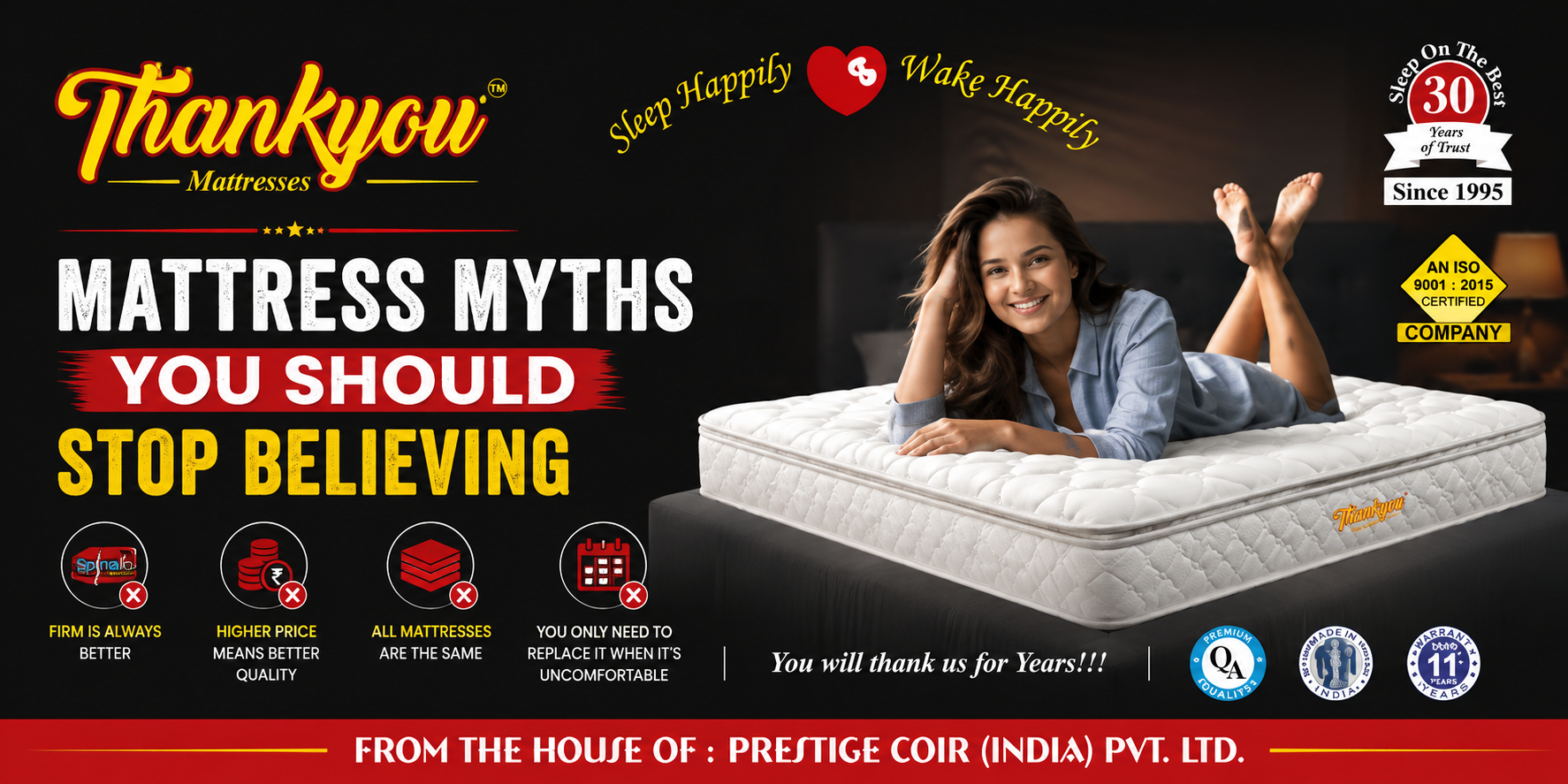
Ask five people what makes a “good” mattress and you’ll probably get five different answers — most of them wrong. Mattress advice in India gets passed around like a family recipe: from parents, from the uncle who swears by his 20-year-old cotton-filled bed, from the salesman who just wants to close a sale before lunch. Somewhere along the way, a lot of half-truths hardened into “facts.”
We’re Thankyou Mattresses, and honestly, we’d rather you buy the right mattress from anywhere than the wrong one from us. So here’s a rundown of the myths we hear most often, and what’s actually true.
“Harder is always better for your back”
This one refuses to die. Somehow an entire generation grew up believing that if a mattress doesn’t feel like sleeping on a plank of wood, it’s not doing its job.
Here’s the problem: a mattress that’s too firm doesn’t support your spine — it just pushes back against it. Your shoulders and hips, being the widest parts of your body, end up taking all the pressure while the rest of you barely touches the surface. Over time that’s a recipe for stiffness, not relief.
What your spine actually wants is something closer to medium-firm — support that still holds its shape but gives a little where your body needs it to. That’s part of why contour memory foam pillow designs caught on the way they did. Instead of forcing your neck to adjust to the pillow, the pillow adjusts to your neck.
“One mattress is pretty much like another”
It’s tempting to think mattresses are interchangeable once they’re covered in the same white fabric. They’re not, and the difference usually isn’t visible from the outside. A few things that actually separate a decent mattress from a mediocre one:
- What’s inside — foam, latex, springs, or some hybrid mix of all three
- How the layers are built, since that’s what determines whether it lasts five years or fifteen
- How well it breathes, especially if you tend to sleep warm
- Edge support, which matters more than people expect if you sit on the bed a lot
This is also where it helps to know who actually made your mattress. Some of the more established mattress manufacturers in Delhi have been refining their layering and foam density for years — it’s not something you can shortcut by copying a design and slapping on a new label.
“The more expensive it is, the better it must be”
Not really. Price tags in this category are heavily influenced by advertising budgets, showroom rent, and brand positioning — not always by what’s inside the mattress. We’ve seen premium-priced mattresses that are, frankly, unremarkable, and mid-range ones that outperform them on every measurable front.
If you want a better filter than price, look at the warranty length, the return or trial policy, and whether the brand is upfront about the materials used. That tells you more than a number on a tag ever will.
“You’ll know it’s time to replace it when it looks worn out”
By the time a mattress visibly sags, it’s usually been failing you quietly for a year or two already. Most mattresses have a realistic lifespan of 7 to 10 years, and the decline is gradual — you wake up a little stiffer, you shift positions more at night, you blame it on stress or your pillow. Rarely do people connect it back to the mattress itself until it’s obviously falling apart.
If you’re waking up with aches that ease up once you’re out of bed and moving around, that’s usually your mattress talking, not your body.
“The pillow doesn’t matter much, as long as the mattress is good”
The mattress gets all the credit, but your neck and shoulders don’t care how good your mattress is if your pillow is flat, lumpy, or trapping heat all night. This is one area where a pure cotton pillow earns its reputation — breathable, low on synthetic buildup, and generally kinder to people with allergies or sensitive skin. Get the mattress right and ignore the pillow, and you’ve really only solved half the problem.
“Memory foam always sleeps hot”
Fair complaint, outdated by now. Early memory foam did trap heat — that reputation wasn’t invented out of nowhere. But foam manufacturing has moved on quite a bit since then. Gel-infused layers, open-cell structures, better airflow channels — a lot of modern foam is built specifically to stop that heat-trapping problem, so judging it by decade-old standards isn’t really fair anymore.
“Everyone in the house can share the same type of mattress”
Convenient in theory, rarely true in practice. A side sleeper needs more give at the shoulder and hip. A back sleeper usually wants firmer, more even support. Throw in differences in body weight and age, and “one mattress fits all” starts to look more like a compromise everyone tolerates than a solution anyone’s happy with.
“Five minutes in a showroom tells you everything”
It really doesn’t. Lying on a mattress for a few minutes under showroom lighting, fully dressed, mid-afternoon, tells you almost nothing about how it’ll feel at 3 a.m. after a long day. Your body needs a few nights — sometimes a couple of weeks — to actually settle in and reveal whether a mattress works for you. That’s exactly why trial periods exist, and why skipping straight to a decision in-store is one of the more common regrets we hear about.
The takeaway
Most mattress myths survive simply because nobody questions them — they get repeated often enough that they start to sound like common sense. But your spine, your sleep, and your budget deserve better than inherited assumptions. Look past the marketing, ask about materials, take advantage of trial periods, and pick what actually works for your body — not what everyone else says worked for theirs.
FAQs
- Is a firm mattress really better for back pain?
Not always — a medium-firm mattress usually supports the spine better than an overly hard one, which can create pressure points at the hips and shoulders.
- How long does a mattress actually last?
Around 7 to 10 years on average, though support quality often declines gradually before any visible wear shows up.
- Does a higher price always mean a better mattress?
No — price is often driven by marketing and branding, so warranty terms and material quality are better indicators of value.
- Does memory foam still sleep hot?
Not as much as it used to. Newer foam designs use gel infusions and open-cell structures that significantly improve airflow.
- Can one mattress work for every family member?
Not really — sleeping position, body weight, and age all affect what firmness level actually feels comfortable and supportive.
- How important is the pillow compared to the mattress?
Just as important. A poor pillow can undo the neck and shoulder support that a good mattress provides.
- What’s the benefit of a pure cotton pillow?
It’s breathable, low-allergen, and generally more comfortable for people who sleep warm or have sensitive skin.
- How can I tell if a mattress is good quality?
Check the core material, layering, breathability, and edge support rather than relying on how it looks or feels for a few minutes.
- Why do mattress trial periods matter?
Because it takes several nights for your body to properly adjust, a short showroom test can’t predict long-term comfort.
- What should I look for in a mattress manufacturer?
Look for established manufacturers with clear certifications, consistent quality control, and transparent warranty policies.
Leave a Reply